2017-04-07

[OPEN POSITION]: PhD-position in solid state physics – X-ray and Neutron scattering

PhD-position in solid state physics – X-ray and Neutron scattering

Published: 2017-04-04
Uppsala University is an international research university focused on the development of science and education. Our most important assets are all the individuals who with their curiosity and their dedication make Uppsala University one of Sweden’s most exciting work places. Uppsala University has 40,000 students, 7,000 employees and a turnover of SEK 6,5 billion.
A PhD-position in solid state physics – X-ray and Neutron scattering in the subject Engineering Science with specialization in the solid state physics, at the Ångström Laboratory, Department of Engineering Sciences, Division of Solid state physics (http://teknik.uu.se/solid-state-physics+/?languageId=3). Starting date as soon as possible.
This project will be conducted as part of a collaborative effort between Structural Chemistry and Solid State Physics, both situated at the Ångström Laboratory. The Ångström Advanced Battery Centre at Structural chemistry is the largest battery research group in the Nordic countries. Our research focuses on all aspects of the chemistry of rechargeable batteries; recently, we are looking at advanced nanomaterials with the aim of making energy storage more sustainable and cost-effective. The Magnetism group at the division of Solid State Physics is working with experimental research on novel magnetic materials, and has made key contributions to this research field. Apart from pursuing basic research on magnetic materials, the group is also involved in interdisciplinary research; developing magnetic nanoparticle based bioassays, and the study of the magnetization dynamics of self-assembled nanoparticle assemblies.
The PhD project will focus on the characterization of nanomaterials using neutron and X-ray scattering. The focal point of the project is the combination of scattering techniques at multiple length scales, in order gain insights in materials and processes by covering both the atomic- and the mesoscale. Several different materials will be explored throughout the project, including self-assembled magnetic nanomaterials and battery components. This work is funded by the Swedish research council, with the aim to develop several sample environments for the neutron diffractometer DREAM at the European spallation source (ESS). The work is performed in close collaboration with Stockholm University and involves travel to major facilities in EU and other parts of the world. We offer a varied and exciting work, with well-established collaboration with the department of Chemistry at the Ångström laboratory as well as with nationally and internationally renowned research groups.
We are seeking candidates with a MSc in engineering or science. A strong motivation and ability to work independently is desirable, and good verbal and written skills in English are required. Experience in materials science work will be considered as a merit.
The PhD position is for four years, extendable to a maximum of five years including departmental duties at a level of at most 20% (typically teaching).
Local guidelines for salary placement are used.
Uppsala University aims for gender balance and diversity in all activities in order to achieve a higher quality at all levels of the organization. We therefore welcome applicants of any gender and with different birth background, functionality and life experience.
Applications should include a brief description of research interests and relevant experience, a CV, copies of diplomas and certificates, thesis (or a draft thereof) and other relevant documents. The candidates are encouraged to provide letter(s) of recommendation and contact information to reference persons.
For further information please contact Dr Erik Wetterskog, +46-(0)18-471 3115, erik.wetterskog@angstrom.uu.se
You are welcome to submit your application no later than 25 April 2017, UFV-PA 2017/1102.
We decline offers of recruitment and advertising help. We only accept the application the way described in the advertisement.
Placement: Department of Engineering Sciences
Type of employment: Full time , Temporary position longer than 6 months
Pay: Fixed pay
Number of positions: 1
Working hours: 100 %
Town: Uppsala
County: Uppsala län
Country: Sweden
Union representative: Ellena Papaioannou, Seko 018-471 3315
Marie Ols, TCO/ST 018-471 2459
Per Sundman, Saco-rådet 018-471 1485 
Number of reference: UFV-PA 2017/1202
Last application date: 2017-04-25

[OPEN POSITION] Postdoctoral Fellow in Materials Chemistry - Neutron Scattering

Postdoctoral Fellow in Materials Chemistry - Neutron Scattering

Ref. No. SU FV-0992-17

at the Department of Materials and Environmental ChemistryClosing date: 30 April 2017.
The Department of Materials and Environmental Chemistry at Stockholm University is one of the largest with about 150 persons working with the synthesis and structural characterisation of materials.
Project description
We are looking for a postdoc who can carry out research with neutron diffraction and SANS of nanomaterials with technical applications as biomaterials, battery components and potentially magnetic materials.
The project is a collaboration between Stockholm University, Uppsala University and the European Spallation Source (ESS) and has as a long-term plan to expand the neutron diffractometer DREAM at the ESS in Lund to study nanomaterials. Within the project, we will design different sample environments to enable the simultaneous acquisition of data in two length scales (atomic and nanoscopic). This will be used to study three different materials classes that have a strong research tradition in Sweden: biomaterials, batteries, and magnetic materials. In this way, the connection between the variations in the crystal structure and nanoparticle morphology can be established. Some examples of the possible studies include the self-assembly of small cellulose fibres, how the structure of batteries changes during usage, or how magnetic nanoparticles assemble under an applied magnetic field. The project is financed by the Swedish Research Council.
Main responsibilities
The postdoctoral fellow will work together with a team that will focus in studying different types of nanomaterials with neutron scattering at the atomic (diffraction) and nanoscopic (small angle neutron scattering, SANS) levels. The work implies comprehensive experiments with neutron scattering in neutron facilities around the world with the focus on the multiple length scale approach. The work also includes the design, development, and testing of different sample environments for the in-situ characterisation of two different types of nanomaterials such as nanocellulose and iron oxide nanoparticles.
Qualification requirements
Postdoctoral positions are appointed primarily for purposes of research. Applicants are expected to hold a Swedish doctoral degree or an equivalent degree from another country. The applicant should have a doctoral degree in chemistry or physics with a strong focus on condensed matter or similar qualifications.
Assessment criteriaThe degree should have been completed no more than three years before the deadline for applications. An older degree may be acceptable under special circumstances, such as sick leave, parental leave, clinical attachment, elected positions in trade unions, or similar.
In the appointment process special attention will be given to research skills. Documented experience of neutron scattering is required. Experience in X-ray scattering in general and total scattering in particular is advantageous.
Terms of employment
The position involves full-time employment for a maximum of two years, with the possibility of extension under special circumstances.
Stockholm University strives to be a workplace free from discrimination and with equal opportunities for all.
Contact
Further information about the position can be obtained from the PI, Assoc. Prof. German Salazar-Alvarez, telephone: +46 8 16 39 42, german@mmk.su.se, or Head of Department, Prof. Gunnar Svenson, telephone: +46 8 16 12 54, gunnar@mmk.su.se.
Union representatives
Anqi Lindblom-Ahlm (Saco-S) and Lisbeth Häggberg (Fackförbundet ST and Lärarförbundet), telephone: +46 8 16 20 00 (operator), and seko@seko.su.se (SEKO).
Application
Apply for the position at Stockholm University's recruitment system by clicking the "Apply" button. It is the responsibility of the applicant to ensure that the application is complete in accordance with the instructions in the job advertisement, and that it is submitted before the deadline.
Please include the following information with your application
  • Your contact details and personal data
  • Your highest degree
  • Your language skills
  • Contact details for 2–3 references
and, in addition, please include the following documents
  • Cover letter
  • CV – degrees and other completed courses, work experience and a list of publications
  • Research proposal (no more than 3 pages) describing:
    – why you are interested in the field/project described in the advertisement
    – why and how you wish to complete the project
    – what makes you suitable for the project in question
  • Copy of PhD diploma
  • Letters of recommendation (no more than 3 files)
  • Publications in support of your application (no more than 3 files).
The instructions for applicants are available at: Instructions – Applicants.
Stockholm University – our education and research produce results.

2017-03-23

[Project Grant] Extended DREAM: Multiple-length scale approach to functional nanomaterials


A team led by German Salazar-Alvarez, researcher at the Department of Materials and Environmental Chemistry, Stockholm University, has been awarded 10 MSEK by the Swedish Research Council, VR, to develop sample environments that will allow the in-situ and in-operando multiscale characterization of novel functional nanomaterials such as biomaterials, battery components, and magnetic nanoparticles. Coupled to the high brilliance of the ESS source the project will provide exceptional opportunities for the envisioned materials. Also, testing of the new sample environments at existing neutron facilities will promote the training of the Swedish community in neutron scattering.


Co-applicants:
- Peter Svedlindh and Erik Wetterskog, Uppsala University

Contact:
(german@mmk.su.se)

2017-03-16

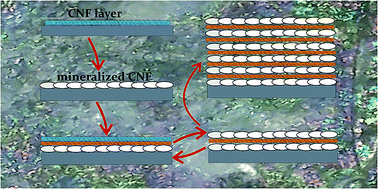
[OPEN ACCESS] A CaCO3/nanocellulose-based bioinspired nacre-like material

Masoud Farhadi-Khouzani, Christina Schütz, Grażyna M. Durak, Jordina Fornell, Jordi Sort, Germán Salazar-Alvarez, Lennart Bergström and Denis Gebauer*

J. Mater. Chem. A, (2017)
DOI:10.1039/C6TA09524K

Abstract:
Nacre continues to be an inspiration for the fabrication of strong and tough materials from renewable and earth-abundant raw materials. Herein, we showed how a nacre-like hybrid material based on nanocellulose (NC) and CaCO3 can be prepared via the sequential infiltration of polymer-stabilised CaCO3 liquid precursors into layers of pre-deposited NC films. Layer-by-layer assembly of the NC films followed by controlled spreading and infiltration with liquid CaCO3 precursors generated a lamellar material with an architecture and iridescent appearance similar to those of nacre. The wettability of the NC films towards the liquid CaCO3 precursors was controlled by hydroxyl and carboxyl functionalization of the NC fibrils and the addition of magnesium ions. The combination of a high stiffness and plasticity of the nacre-like NC/CaCO3 hybrid materials show that excellent mechanical properties can be obtained employing a fibrillar organic constituent that is relatively hard. The fabrication of a nacre-like hybrid material via an aqueous route of assembly and infiltration processing demonstrates how a sustainable composite material with outstanding properties can be produced using the most abundant biopolymer and biomineral on earth.


Extensively interconnected silicon nanoparticles via carbon network derived from ultrathin cellulose nanofibers as high performance lithium ion battery anodes

Jong Min Kim, Valentina Guccini, Kwang-dong Seong, Jiseop Oh, German Salazar-Alvarez*, Yuanzhe Piao*.

Carbon 118 (2017) 8–17
DOI10.1016/j.carbon.2017.03.028

Abstract:
Silicon is a good alternative to conventional graphite anode but it has bad cycling and rate performance. To overcome these severe problems, extensively interconnected silicon nanoparticles using carbon network derived from ultrathin cellulose nanofibers were synthesized. Ultrathin cellulose nanofibers, an abundant and sustainable material, entangle each silicon nanoparticle and become extensively interconnected carbon network after pyrolysis. This wide range interconnection provides an efficient electron path by decreasing the likelihood that electrons experience contact resistivity and also suppresses the volume expansion of silicon during lithiation. In addition, Ultrathin cellulose nanofibers are carboxylated and therefore adhesive to silicon nanoparticles through hydrogen bonding. This property makes ultrathin cellulose the perfect carbon source when making silicon composites. As a consequence, it exhibits 808 mAh g−1 of the reversible capacity after 500 cycles at high current density of 2 A g−1 with a coulombic efficiency of 99.8%. Even at high current density of 8 A g−1, it shows a high reversible discharge capacity of 464 mAh g−1. Moreover, extensively interconnected carbon network prevents the formation of a brittle electrode with a water-based binder. Therefore, this remarkable material has a huge potential for LIBs applications.


2017-03-11

High-performance magnetic activated carbon from solid waste from lignin conversion processes. Part I: Their use as adsorbents for CO2

Wenming Hao, Fredrik Björnerbäck, Yulia Trushkina, Mikel Oregui-Bengoechea, German Salazar-Alvarez, Tanja Barth, and Niklas Hedin

ACS Sustainable Chem. Eng., (2017)
DOI: 10.1021/acssuschemeng.6b02795

Abstract:
Lignin is naturally abundant and a renewable precursor with a potential to be used in the production of both chemicals and materials. As many lignin conversion processes suffer from a significant production of solid wastes in the form of hydrochars, this study focused on transforming hydrochars into magnetic activated carbons (MAC). The hydrochars were produced via hydrothermal treatment of lignins together with formic acid. The activation of the hydrochars was performed chemically with KOH with a focus on the optimization of the MACs as adsorbents for CO2. MACs are potentially relevant to carbon capture and storage (CCS) and gas purification processes. In general, the MACs had high specific surface areas (up to 2875 m2/g), high specific pore volumes, and CO2 adsorption capacities of up to 6.0 mmol/g (1 atm, 0 °C). The textual properties of the MACs depended on the temperature of the activation. MACs activated at a temperature of 700 °C had very high ultramicropore volumes, which are relevant for potential adsorption-driven separation of CO2 from N2. Activation at 800 °C led to MACs with larger pores and very high specific surface areas. This temperature-dependent optimization option, combined with the magnetic properties, provided numerous potential applications of the MACs besides of CCS. The hydrochar derived from eucalyptus lignin, and the corresponding MACs displayed soft magnetic behavior with coercivities of < 100 Oe and saturation magnetization values of 1-10 emu/g.


2016-10-28

Following in real-time the two-step assembly of nanoparticles into mesocrystals in levitating drops

Michael Agthe, Tomás S. Plivelic, Ana Labrador, Lennart Bergström, German Salazar-Alvarez

Nano Letters (2016)

Abstract:
Mesocrystals composed of crystallographically-aligned nanocrystals are present in biominerals and assembled materials which show strongly directional properties of importance for mechanical protection and functional devices. Mesocrystals are commonly formed by complex biomineralisation processes and can also be generated by assembly of anisotropic nanocrystals. Here, we follow the evaporation-induced assembly of maghemite nanocubes into mesocrystals in real-time in levitating drops. Analysis of time-resolved small angle X-ray scattering data and ex-situ scanning electron microscopy together with interparticle potential calculations show that the substrate-free, particle-mediated crystallization process proceeds in two stages involving the formation and rapid transformation of a dense, structurally disordered phase into ordered mesocrystals. Controlling and tailoring the particle-mediated formation of mesocrystals could be utilized to assemble designed nanoparticles into new materials with unique functions.

2016-08-12

Tunable high-field magnetization in strongly exchange-coupled freestanding Co/CoO core/shell coaxial nanowires

German Salazar-Alvarez, Julian Geshev, Sebastia Agramunt-Puig, Carles Navau, Alvar Sanchez, Jordi Sort, and Josep Nogués

ACS Applied Materials and Interfaces, 2016
DOI: 10.1021/acsami.6b05588

Abstract:
The exchange bias properties of Co/CoO coaxial core/shell nanowires have been investigated with cooling and applied fields perpendicular to the wire axis. This configuration leads to unexpected exchange-bias effects. Firstly, the magnetization value at high fields is found to depend on the field-cooling conditions. This effect arises from the competition between the magnetic anisotropy and the Zeeman energies for cooling fields perpendicular to the wire axis. This allows imprinting pre-defined magnetization states to the AFM, as corroborated by micromagnetic simulations. Secondly, the system exhibits a high-field magnetic irreversibility, leading to open hysteresis loops, attributed to the AFM easy-axis reorientation during the reversal (effect similar to athermal training). A distinct way to manipulate the high-field magnetization in exchange-biased systems, beyond the archetypical effects, is thus experimentally and theoretically demonstrated.


2016-07-13

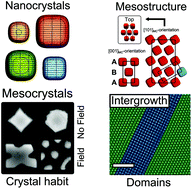
[OPEN ACCESS] Tuning the structure and habit of iron oxide mesocrystals

Erik Wetterskog*, Alice Klapper, Sabrina Disch, Elisabeth Josten, Raphaël P. Hermann, Ulrich Rücker, Thomas Brückel, Lennart Bergström and German Salazar-Alvarez*

Nanoscale (2016)
DOI10.1039/C6NR03776C


Abstract:
A precise control over the meso- and microstructure of ordered and aligned nanoparticle assemblies, i.e., mesocrystals, is essential in the quest of exploiting collective material properties for potential applications. In this work, we produce evaporation-induced self-assembled mesocrystals with different mesostructures and crystal habits based on iron oxide nanocubes by varying the nanocube size and shape, and by applying magnetic fields. A full 3D characterization of the mesocrystals was performed using image analysis, high-resolution scanning electron microscopy and Grazing Incidence Small Angle X-ray Scattering (GISAXS). This enabled structural determination of e.g. multi-domain mesocrystals with complex crystal habits, and the quantification of interparticle distances with sub-nm precision. Mesocrystals of small nanocubes (l = 8.6 – 12.6 nm) are isostructural with a body centred tetragonal (bct) lattice whereas assembly of the largest nanocubes in this study (l = 13.6 nm) additionally form a simple cubic (sc) lattice. The mesocrystal habit can be tuned from a square, hexagonal to star-like and pillar shapes depending on the particle size, shape, and the strength of the applied magnetic field. Finally, we outline a qualitative phase diagram of the evaporation-induced self-assembled superparamagnetic iron oxide nanocube mesocrystals based on nanocube edge length and magnetic field strength.


2016-07-09

3D visualization of iron oxidation state in FeO/Fe3O4 core-shell nanocubes from electron energy loss tomography

Pau Torruella, Raul Arenal, Francisco de la Peña*, Zineb Saghi, Lluís Yedra, Alberto Eljarrat, Lluis Lopez-Conesa, Marta Estrader*, Alberto López-Ortega, German Salazar-Alvarez, Josep Nogués Sanmiquel, Caterina Ducati, Paul A. Midgley, Francesca Peiró, and Sonia Estrade*

Nano Letters, 16 (2016) 5068-5073
DOI: 10.1021/acs.nanolett.6b01922


Abstract:
The physicochemical properties used in numerous advanced nanostructured devices are directly controlled by the oxidation states of their constituents. In this work we combine electron energy-loss spectroscopy, blind source separation, and computed tomography to reconstruct in three dimensions the distribution of Fe2+ and Fe3+ ions in a FeO/Fe3O4 core/shell cube-shaped nanoparticle with nanometric resolution. The results highlight the sharpness of the interface between both oxides and provide an average shell thickness, core volume, and average cube edge length measurements in agreement with the magnetic characterization of the sample.

2016-04-28

[Workshop] Structure elucidation from molecular to macroscopic level


Functional Hybrid Materials: structure elucidation from molecular to macroscopic level – A workshop and training school

Speakers and lecturers

Thomas Albrecht-Schmitt, Florida State University
Zoltán Bacsik, Stockholm University
Lennart Bergström, Stockholm University
Luís Carlos, University of Aveiro
Marie-Helene Delville, Institute of Chemistry of Condensed Matter of Bordeaux
Thierry Darmanin, University of Nice
Niklas Hedin, Stockholm University
Andrew Ken Inge, Stockholm University
Vadim Kessler, Swedish University of Agricultural Sciences
Nicholas Kotov, University of Michigan
Carita Kvarnström, University of Turku
Danielle LaurencinInstitute Charles Gerhard of Montpellier
Jean-Marie Nedelec, Institute of Chemistry of Clermont-Ferrand
Tomás Plivelic, MAX IV synchrotron
Meital Reches, Hebrew University of Jerusalem
João Rocha, University of Aveiro
German Salazar-Alvarez, Stockholm University
Nico Sommerdijk, Eindhoven University of Technology
Andreas Taubert, University of Potsdam
Wei Wan, Stockholm University
Max Wolff, Uppsala University
Xiaodong Zou, Stockholm University

The school aims at giving an overview of structure elucidation techniques relevant for the design of new hybrid materials. A recommendation of 1.5 ECTS will be given to students attending all lectures and presenting a poster. Deadline registration April 30th, 2016.

Registration free of charge. Details at http://www.tinc.nu/

Organizers
German Salazar-Alvarez, Stockholm University
Vadim KesslerSwedish University of Agricultural Sciences

Sponsored by:

2016-01-11

Thin Water Films at Multifaceted Hematite Particle Surfaces

Jean-François Boily, Merve Yeşilbaş, Munshi Md. Musleh Uddin, Lu Baiqing, Yulia Trushkina, and Germàn Salazar-Alvarez

Langmuir, 31 (2015) 13127–13137
DOI: 10.1021/acs.langmuir.5b03167

Abstract:
Mineral surfaces exposed to moist air stabilize nanometer- to micrometer-thick water films. This study resolves the nature of thin water film formation at multifaceted hematite (α-Fe2O3) nanoparticle surfaces with crystallographic faces resolved by selected area electron diffraction. Dynamic vapor adsorption (DVA) in the 0–19 Torr range at 298 K showed that these particles stabilize water films consisting of up to 4–5 monolayers. Modeling of these data predicts water loadings in terms of an “adsorption regime” (up to 16 H2O/nm2) involving direct water binding to hematite surface sites, and of a “condensation regime” (up to 34 H2O/nm2) involving water binding to hematite-bound water nanoclusters. Vibration spectroscopy identified the predominant hematite surface hydroxo groups (−OH, μ–OH, μ3–OH) through which first layer water molecules formed hydrogen bonds, as well as surface iron sites directly coordinating water molecules (i.e., as geminal η–(OH2)2 sites). Chemometric analyses of the vibration spectra also revealed a strong correspondence in the response of hematite surface hydroxo groups to DVA-derived water loadings. These findings point to a near-saturation of the hydrogen-bonding environment of surface hydroxo groups at a partial water vapor pressure of ∼8 Torr (∼40% relative humidity). Classical molecular dynamics (MD) resolved the interfacial water structures and hydrogen bonding populations at five representative crystallographic faces expressed in these nanoparticles. Simulations of single oriented slabs underscored the individual roles of all (hydro)oxo groups in donating and accepting hydrogen bonds with first layer water in the “adsorption regime”. These analyses pointed to the preponderance of hydrogen bond-donating −OH groups in the stabilization of thin water films. Contributions of μ–OH and μ3–OH groups are secondary, yet remain essential in the stabilization of thin water films. MD simulations also helped resolve crystallographic controls on water–water interactions occurring in the “condensation regime”. Water–water hydrogen bond populations are greatest on the (001) face, and decrease in importance in the order (001) > (012) ≈ (110) > (014) ≫ (100). Simulations of a single (∼5 nm × ∼ 6 nm × ∼ 6 nm) nanometric hematite particle terminated by the (001), (110), (012), and (100) faces also highlighted the key roles that sites at particle edges play in interconnecting thin water films grown along contiguous crystallographic faces. Hydroxo–water hydrogen bond populations showed that edges were the preferential loci of binding. These simulations also suggested that equilibration times for water binding at edges were slower than on crystallographic faces. In this regard, edges, and by extension roughened surfaces, are expected to play commanding roles in the stabilization of thin water films. Thus, in focusing on the properties of nanometric-thick water layers at hematite surfaces, this study revealed the nature of interactions between water and multifaced particle surfaces. Our results pave the way for furthering our understanding of mineral-thin water film interfacial structure and reactivity on a broader range of materials.


2015-09-01

Controlled molecular reorientation enables strong cellulose fibers regenerated from ionic liquid solutions

Johan Sundberg, Valentina Guccini, Karl M.O. Håkansson, German Salazar-Alvarez, Guillermo Toriz, Paul Gatenholm

Polymer 75 (2015) 119-124.
DOI: 10.1016/j.polymer.2015.08.035

Highlights:
• Strong cellulose fibers spun from ionic liquid solution.
• Extrusion process simulated in silica based upon rheological measurements.
• Increased DO for fibers regenerated with ethanol stretched at high RH.
• Significant improvement of mechanical properties for re-oriented fibers.
• Mechanical properties comparable to commercially available fibers.

Abstract:
Cellulose is difficult to solubilize and undergoes thermal decomposition prior to melting. In recent years ionic liquids have been evaluated as solvents of cellulose. In the regeneration process the non-solvent governs the resulting material's crystallinity. Water adsorbs to amorphous cellulose, acts as plasticizer and lowers the Tg, hence the degree of crystallinity will affect the potential strain induced reorientation. We prepared regenerated cellulose fibers form ionic liquid using different non-solvents. The influence of shear forces upon cellulose chain alignment during extrusion was simulated in silica based upon rheological measurements. The regenerated fibers had different physical, morphological and mechanical properties. Molecular re-orientation in fibers induced by mechanical strain, at humidities above the Tg, resulted in much improved mechanical properties with the Young's modulus reaching 23.4 ± 0.8 GPa and the stress at break 504.6 ± 51.9 MPa, which is comparable to commercially available cellulose fibers.