2016-07-13
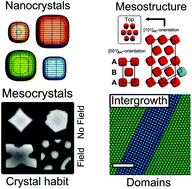
[OPEN ACCESS] Tuning the structure and habit of iron oxide mesocrystals
Nanoscale (2016)
DOI: 10.1039/C6NR03776C
Abstract:
A precise control over the meso- and microstructure of ordered and aligned nanoparticle assemblies, i.e., mesocrystals, is essential in the quest of exploiting collective material properties for potential applications. In this work, we produce evaporation-induced self-assembled mesocrystals with different mesostructures and crystal habits based on iron oxide nanocubes by varying the nanocube size and shape, and by applying magnetic fields. A full 3D characterization of the mesocrystals was performed using image analysis, high-resolution scanning electron microscopy and Grazing Incidence Small Angle X-ray Scattering (GISAXS). This enabled structural determination of e.g. multi-domain mesocrystals with complex crystal habits, and the quantification of interparticle distances with sub-nm precision. Mesocrystals of small nanocubes (l = 8.6 – 12.6 nm) are isostructural with a body centred tetragonal (bct) lattice whereas assembly of the largest nanocubes in this study (l = 13.6 nm) additionally form a simple cubic (sc) lattice. The mesocrystal habit can be tuned from a square, hexagonal to star-like and pillar shapes depending on the particle size, shape, and the strength of the applied magnetic field. Finally, we outline a qualitative phase diagram of the evaporation-induced self-assembled superparamagnetic iron oxide nanocube mesocrystals based on nanocube edge length and magnetic field strength.
2016-01-11
Thin Water Films at Multifaceted Hematite Particle Surfaces
Langmuir, 31 (2015) 13127–13137
DOI: 10.1021/acs.langmuir.5b03167
Abstract:
Mineral surfaces exposed to moist air stabilize nanometer- to micrometer-thick water films. This study resolves the nature of thin water film formation at multifaceted hematite (α-Fe2O3) nanoparticle surfaces with crystallographic faces resolved by selected area electron diffraction. Dynamic vapor adsorption (DVA) in the 0–19 Torr range at 298 K showed that these particles stabilize water films consisting of up to 4–5 monolayers. Modeling of these data predicts water loadings in terms of an “adsorption regime” (up to 16 H2O/nm2) involving direct water binding to hematite surface sites, and of a “condensation regime” (up to 34 H2O/nm2) involving water binding to hematite-bound water nanoclusters. Vibration spectroscopy identified the predominant hematite surface hydroxo groups (−OH, μ–OH, μ3–OH) through which first layer water molecules formed hydrogen bonds, as well as surface iron sites directly coordinating water molecules (i.e., as geminal η–(OH2)2 sites). Chemometric analyses of the vibration spectra also revealed a strong correspondence in the response of hematite surface hydroxo groups to DVA-derived water loadings. These findings point to a near-saturation of the hydrogen-bonding environment of surface hydroxo groups at a partial water vapor pressure of ∼8 Torr (∼40% relative humidity). Classical molecular dynamics (MD) resolved the interfacial water structures and hydrogen bonding populations at five representative crystallographic faces expressed in these nanoparticles. Simulations of single oriented slabs underscored the individual roles of all (hydro)oxo groups in donating and accepting hydrogen bonds with first layer water in the “adsorption regime”. These analyses pointed to the preponderance of hydrogen bond-donating −OH groups in the stabilization of thin water films. Contributions of μ–OH and μ3–OH groups are secondary, yet remain essential in the stabilization of thin water films. MD simulations also helped resolve crystallographic controls on water–water interactions occurring in the “condensation regime”. Water–water hydrogen bond populations are greatest on the (001) face, and decrease in importance in the order (001) > (012) ≈ (110) > (014) ≫ (100). Simulations of a single (∼5 nm × ∼ 6 nm × ∼ 6 nm) nanometric hematite particle terminated by the (001), (110), (012), and (100) faces also highlighted the key roles that sites at particle edges play in interconnecting thin water films grown along contiguous crystallographic faces. Hydroxo–water hydrogen bond populations showed that edges were the preferential loci of binding. These simulations also suggested that equilibration times for water binding at edges were slower than on crystallographic faces. In this regard, edges, and by extension roughened surfaces, are expected to play commanding roles in the stabilization of thin water films. Thus, in focusing on the properties of nanometric-thick water layers at hematite surfaces, this study revealed the nature of interactions between water and multifaced particle surfaces. Our results pave the way for furthering our understanding of mineral-thin water film interfacial structure and reactivity on a broader range of materials.
2015-06-30
[OPEN ACCESS] Fabrication of nanocellulose–hydroxyapatite composites and their application as water-resistant transparent coatings
J. Mater. Chem. B, 2015, Advance Article
DOI: 10.1039/C5TB00927H
Abstract
Nanosized composite rods ~300 nm in length and ~20 nm in width were produced by deposition of 22–77 wt% of a c-axis-oriented hydroxyapatite (HA) on cellulose nanocrystals (CNCs). The CNCs functionalized with sulphonic groups were covered with the HA nanocrystals through controlled nucleation and growth under a moderately supersaturated condition in a solution system based on a simulated body fluid. Water-resistant transparent coatings 2–4 μm thick were obtained via evaporation-induced assembly of CNC–HA nanocomposites by casting their suspension on a glass substrate and the subsequent growth of HA nanocrystals by vapour hydrothermal treatment. The composite coatings exhibited improved mechanical strength compared to that of crustacean exoskeletons, and potential for bone regeneration.
2014-11-02
[OPEN ACCESS] Precise control over shape and size of iron oxide nanocrystals suitable for assembly into ordered particle arrays
Sci. Technol. Adv. Mater. 15 (2014) 055010
DOI:10.1088/1468-6996/15/5/055010
Abstract
Here we demonstrate how monodisperse iron oxide nanocubes and nanospheres with average sizes between 5 and 27 nm can be synthesized by thermal decomposition. The relative importance of the purity of the reactants, the ratio of oleic acid and sodium oleate, the maximum temperature, and the rate of temperature increase, on robust and reproducible size and shape-selective iron oxide nanoparticle synthesis are identified and discussed. The synthesis conditions that generate highly monodisperse iron oxide nanocubes suitable for producing large ordered arrays, or mesocrystals are described in detail.
2014-10-10
Applications of exchange coupled bi-magnetic hard/soft and soft/hard magnetic core/shell nanoparticles
Physics Reports, 2014, accepted manuscript
DOI: 10.1016/j.physrep.2014.09.007
Abstract:
The applications of exchange coupled bi-magnetic hard/soft and soft/hard ferromagnetic core/shell nanoparticles are reviewed. After a brief description of the main synthesis approaches and the core/shell structural-morphological characterization, the basic static and dynamic magnetic properties are presented. Five different types of prospective applications, based on diverse patents and research articles, are described: permanent magnets, recording media, microwave absorption, biomedical applications and other applications. Both the advantages of the core/shell morphology and some of the remaining challenges are discussed.
2013-10-31
[OPEN ACCESS] Dynamic growth modes of ordered arrays and mesocrystals during drop-casting of iron oxide nanocubes
DOI: 10.1039/C3CE41871E
Michael Agthe, Erik Wetterskog, Johanne Mouzon, German Salazar-Alvarez and Lennart Bergström
The growth modes of self-assembled mesocrystals and ordered arrays from dispersions of iron oxide nanocubes with a mean edge length of 9.6 nm during controlled solvent removal have been investigated with a combination of visible light video microscopy, atomic force microscopy and scanning electron microscopy. Mesocrystals with translational and orientational order of sizes up to 10 μm are formed spontaneously during the final, diffusion-controlled, drop-casting stage when the liquid film is very thin and the particle concentration is high. Convection-driven deposition of ordered nanocube arrays at the edge of the drying droplet is a manifestation of the so called coffee-ring effect. Dendritic growth or fingering of rapidly growing arrays of ordered nanocubes could also be observed in a transition regime as the growth front moves from the initial three-phase contact line towards the centre of the original droplet.
Video abstract:
Cover page:
http://pubs.rsc.org.ezp.sub.su.se/en/content/articlepdf/2014/ce/c4ce90010c?page=search
2013-08-05
[OPEN ACCESS] Anomalous Magnetic Properties of Nanoparticles Arising from Defect Structures: Topotaxial Oxidation of Fe1-xO|Fe3-δO4 Core|Shell Nanocubes to Single-Phase Particles
ACS Nano, 2013
DOI: 10.1021/nn402487q2013-03-05
[OPEN ACCESS] Structural diversity in iron oxide nanoparticle assemblies as directed by particle morphology and orientation
Nanoscale, 2013, Just Accepted Manuscript
Sabrina Disch, Erik Wetterskog, Raphaël P. Hermann, Denis Korolkov, Peter Busch, Peter Boesecke, Olivier Lyon, Ulla Vainio, German Salazar-Alvarez, Lennart Bergström and Thomas Brückel
DOI: 10.1039/C3NR33282A
Abstract:
The mesostructure of ordered arrays of anisotropic nanoparticles is controlled by a combination of packing constraints and interparticle interactions, two factors that are strongly dependent on the particle morphology. We have investigated how the degree of truncation of iron oxide nanocubes controls the mesostructure and particle orientation in drop cast mesocrystal arrays. The combination of grazing incidence small angle X-ray scattering and scanning electron microscopy shows that mesocrystals of highly truncated cubic nanoparticles assemble in an fcc-type mesostructure - similar to arrays formed by iron oxide nanospheres, but with a significantly reduced packing density and displaying two different growth orientations. Strong satellite reflections in the GISAXS pattern indicate a commensurate mesoscopic superstructure that is related to stacking faults in mesocrystals of the anisotropic nanocubes. Our results show how subtle variation in shape anisotropy can induce oriented arrangements of nanoparticles of different structures and also create mesoscopic superstructures of larger periodicity.