Showing posts with label cubic morphology. Show all posts

2016-07-13

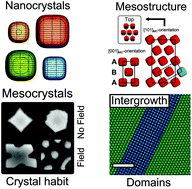
[OPEN ACCESS] Tuning the structure and habit of iron oxide mesocrystals

Erik Wetterskog*, Alice Klapper, Sabrina Disch, Elisabeth Josten, Raphaël P. Hermann, Ulrich Rücker, Thomas Brückel, Lennart Bergström and German Salazar-Alvarez*

Nanoscale (2016)
DOI10.1039/C6NR03776C


Abstract:
A precise control over the meso- and microstructure of ordered and aligned nanoparticle assemblies, i.e., mesocrystals, is essential in the quest of exploiting collective material properties for potential applications. In this work, we produce evaporation-induced self-assembled mesocrystals with different mesostructures and crystal habits based on iron oxide nanocubes by varying the nanocube size and shape, and by applying magnetic fields. A full 3D characterization of the mesocrystals was performed using image analysis, high-resolution scanning electron microscopy and Grazing Incidence Small Angle X-ray Scattering (GISAXS). This enabled structural determination of e.g. multi-domain mesocrystals with complex crystal habits, and the quantification of interparticle distances with sub-nm precision. Mesocrystals of small nanocubes (l = 8.6 – 12.6 nm) are isostructural with a body centred tetragonal (bct) lattice whereas assembly of the largest nanocubes in this study (l = 13.6 nm) additionally form a simple cubic (sc) lattice. The mesocrystal habit can be tuned from a square, hexagonal to star-like and pillar shapes depending on the particle size, shape, and the strength of the applied magnetic field. Finally, we outline a qualitative phase diagram of the evaporation-induced self-assembled superparamagnetic iron oxide nanocube mesocrystals based on nanocube edge length and magnetic field strength.

2014-02-10

Spin excitations in cubic maghemite nanoparticles studied by time-of-flight neutron spectroscopy

Phys. Rev. B 89, 064402 (2014)
DOI: 10.1103/PhysRevB.89.064402

S. Disch, R. P. Hermann, E. Wetterskog, A. A. Podlesnyak, K. An, T. Hyeon, G. Salazar-Alvarez, L. Bergström, and Th. Brückel

Abstract:

We have determined the field dependence of collective magnetic excitations in iron oxide nanoparticles of cubic shape with 8.42(2) nm edge length and a narrow log normal size distribution of 8.2(2)% using time-of-flight neutron spectroscopy. The energy dependence of the uniform precession modes was investigated up to 5 T applied field and yields a Landé factor g=2.05(2) as expected for maghemite (γ-Fe2O3) nanoparticles. A large effective anisotropy field of BA,eff=0.45(16) T was determined, in excellent agreement with macroscopic measurements. This anisotropy is attributed to enhanced shape anisotropy in these monodisperse cubic nanoparticles. The combination of our results with macroscopic magnetization information provides a consistent view of the energy scales of superparamagnetic relaxation and collective magnetic excitations in magnetic nanoparticles.

2013-03-05

[OPEN ACCESS] Structural diversity in iron oxide nanoparticle assemblies as directed by particle morphology and orientation


Nanoscale, 2013, Just Accepted Manuscript

Sabrina Disch,  Erik Wetterskog,  Raphaël P. Hermann,  Denis Korolkov,  Peter Busch,  Peter Boesecke,  Olivier Lyon,  Ulla Vainio,  German Salazar-Alvarez,  Lennart Bergström and Thomas Brückel

DOI: 10.1039/C3NR33282A

Abstract:

The mesostructure of ordered arrays of anisotropic nanoparticles is controlled by a combination of packing constraints and interparticle interactions, two factors that are strongly dependent on the particle morphology. We have investigated how the degree of truncation of iron oxide nanocubes controls the mesostructure and particle orientation in drop cast mesocrystal arrays. The combination of grazing incidence small angle X-ray scattering and scanning electron microscopy shows that mesocrystals of highly truncated cubic nanoparticles assemble in an fcc-type mesostructure - similar to arrays formed by iron oxide nanospheres, but with a significantly reduced packing density and displaying two different growth orientations. Strong satellite reflections in the GISAXS pattern indicate a commensurate mesoscopic superstructure that is related to stacking faults in mesocrystals of the anisotropic nanocubes. Our results show how subtle variation in shape anisotropy can induce oriented arrangements of nanoparticles of different structures and also create mesoscopic superstructures of larger periodicity.

2011-09-21

Cubic versus spherical magnetic nanoparticles: The role of surface anisotropy

http://pubs.acs.org/doi/abs/10.1021/ja0768744

J. Am. Chem. Soc., 2008, 130 (40), pp 13234–13239
G. Salazar-Alvarez, J. Qin, V. Sepelák, I. Bergmann, M. Vasilakaki, K. N. Trohidou, J. D. Ardisson, W. A. A. Macedo, M. Mikhaylova, M. Muhammed, M. D. Baró, J. Nogués

DOI: 10.1021/ja0768744
Abstract:
The magnetic properties of maghemite (γ-Fe2O3) cubic and spherical nanoparticles of similar sizes have been experimentally and theoretically studied. The blocking temperature, TB, of the nanoparticles depends on their shape, with the spherical ones exhibiting larger TB. Other low temperature properties such as saturation magnetization, coercivity, loop shift or spin canting are rather similar. The experimental effective anisotropy and the Monte Carlo simulations indicate that the different random surface anisotropy of the two morphologies combined with the low magnetocrystalline anisotropy of γ-Fe2O3 is the origin of these effects.