Showing posts with label nanocellulose. Show all posts

2017-10-09

Effects of Different Manufacturing Processes on TEMPO-oxidized CNF Performance as binder for Flexible Lithium-ion Batteries

Huiran Lu, Valentina Guccini, Hyeyun Kim, German Salazar-Alvarez, Göran Lindbergh, and Ann Cornell*

ACS Appl. Mater. Interfaces (2017)
DOI: 10.1021/acsami.7b10307

Abstract:
Carboxylated cellulose nanofibers (CNF) prepared using the TEMPO-route are good binders of electrode components in flexible lithium-ion batteries (LIB). However, the different parameters employed for the defibrillation of CNF, such as charge density and degree of homogenization, affect its properties when used as binder. This work presents a systematic study of CNF prepared with different surface charge densities and various degrees of homogenization and their performance as binder for flexible LiFePO4 electrodes. The results show that the CNF with high charge density had shorter fiber lengths compared with the CNF with low charge density, as observed with atomic force microscope (AFM). Also, CNF processed with a large number of passes in the homogenizer showed a better fiber dispersibility, as observed with rheological measurements. The electrodes fabricated with highly charged CNF exhibited the best mechanical and electrochemical properties. The CNF at the highest charge density (1550 µmol g-1) and lowest degree of homogenization (3+3 passes in the homogenizer) achieved the overall best performance, including a high Young’s modulus of approximately 311 MPa and a good rate capability with a stable specific capacity of 116 mAh g-1 even up to 1C. This work allows a better understanding of the influence of the processing parameters of CNF on their performance as binder for flexible electrodes. The results can also contribute to the understanding of the optimal processing parameters of CNF to fabricate other materials, e.g., membranes or separators.

2017-03-23

[Project Grant] Extended DREAM: Multiple-length scale approach to functional nanomaterials


A team led by German Salazar-Alvarez, researcher at the Department of Materials and Environmental Chemistry, Stockholm University, has been awarded 10 MSEK by the Swedish Research Council, VR, to develop sample environments that will allow the in-situ and in-operando multiscale characterization of novel functional nanomaterials such as biomaterials, battery components, and magnetic nanoparticles. Coupled to the high brilliance of the ESS source the project will provide exceptional opportunities for the envisioned materials. Also, testing of the new sample environments at existing neutron facilities will promote the training of the Swedish community in neutron scattering.


Co-applicants:
- Peter Svedlindh and Erik Wetterskog, Uppsala University

Contact:
(german@mmk.su.se)

2017-03-16

[OPEN ACCESS] A CaCO3/nanocellulose-based bioinspired nacre-like material

Masoud Farhadi-Khouzani, Christina Schütz, Grażyna M. Durak, Jordina Fornell, Jordi Sort, Germán Salazar-Alvarez, Lennart Bergström and Denis Gebauer*

J. Mater. Chem. A, (2017)
DOI:10.1039/C6TA09524K

Abstract:
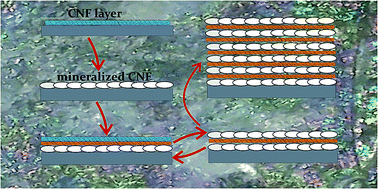
Nacre continues to be an inspiration for the fabrication of strong and tough materials from renewable and earth-abundant raw materials. Herein, we showed how a nacre-like hybrid material based on nanocellulose (NC) and CaCO3 can be prepared via the sequential infiltration of polymer-stabilised CaCO3 liquid precursors into layers of pre-deposited NC films. Layer-by-layer assembly of the NC films followed by controlled spreading and infiltration with liquid CaCO3 precursors generated a lamellar material with an architecture and iridescent appearance similar to those of nacre. The wettability of the NC films towards the liquid CaCO3 precursors was controlled by hydroxyl and carboxyl functionalization of the NC fibrils and the addition of magnesium ions. The combination of a high stiffness and plasticity of the nacre-like NC/CaCO3 hybrid materials show that excellent mechanical properties can be obtained employing a fibrillar organic constituent that is relatively hard. The fabrication of a nacre-like hybrid material via an aqueous route of assembly and infiltration processing demonstrates how a sustainable composite material with outstanding properties can be produced using the most abundant biopolymer and biomineral on earth.


Extensively interconnected silicon nanoparticles via carbon network derived from ultrathin cellulose nanofibers as high performance lithium ion battery anodes

Jong Min Kim, Valentina Guccini, Kwang-dong Seong, Jiseop Oh, German Salazar-Alvarez*, Yuanzhe Piao*.

Carbon 118 (2017) 8–17
DOI10.1016/j.carbon.2017.03.028

Abstract:
Silicon is a good alternative to conventional graphite anode but it has bad cycling and rate performance. To overcome these severe problems, extensively interconnected silicon nanoparticles using carbon network derived from ultrathin cellulose nanofibers were synthesized. Ultrathin cellulose nanofibers, an abundant and sustainable material, entangle each silicon nanoparticle and become extensively interconnected carbon network after pyrolysis. This wide range interconnection provides an efficient electron path by decreasing the likelihood that electrons experience contact resistivity and also suppresses the volume expansion of silicon during lithiation. In addition, Ultrathin cellulose nanofibers are carboxylated and therefore adhesive to silicon nanoparticles through hydrogen bonding. This property makes ultrathin cellulose the perfect carbon source when making silicon composites. As a consequence, it exhibits 808 mAh g−1 of the reversible capacity after 500 cycles at high current density of 2 A g−1 with a coulombic efficiency of 99.8%. Even at high current density of 8 A g−1, it shows a high reversible discharge capacity of 464 mAh g−1. Moreover, extensively interconnected carbon network prevents the formation of a brittle electrode with a water-based binder. Therefore, this remarkable material has a huge potential for LIBs applications.


2015-07-02

[OPEN ACCESS] Rod Packing in Chiral Nematic Cellulose Nanocrystal Dispersions Studied by Small-Angle X-ray Scattering and Laser Diffraction

Christina Schütz, Michael Agthe, Andreas B. Fall, Korneliya Gordeyeva, Valentina Guccini, Michaela Salajková, Tomás S. Plivelic, Jan P. F. Lagerwall, German Salazar-Alvarez, and Lennart Bergström
Langmuir 31 (2015) 6507–6513.
DOI: 10.1021/acs.langmuir.5b00924

Abstract
The packing of cellulose nanocrystals (CNC) in the anisotropic chiral nematic phase has been investigated over a wide concentration range by small-angle X-ray scattering (SAXS) and laser diffraction. The average separation distance between the CNCs and the average pitch of the chiral nematic phase have been determined over the entire isotropic–anisotropic biphasic region. The average separation distances range from 51 nm, at the onset of the anisotropic phase formation, to 25 nm above 6 vol % (fully liquid crystalline phase) whereas the average pitch varies from ≈15 μm down to ≈2 μm as ϕ increases from 2.5 up to 6.5 vol %. Using the cholesteric order, we determine that the twist angle between neighboring CNCs increases from about 1° up to 4° as ϕ increases from 2.5 up to 6.5 vol %. The dependence of the twisting on the volume fraction was related to the increase in the magnitude of the repulsive interactions between the charged rods as the average separation distance decreases.

2015-06-30

[OPEN ACCESS] Fabrication of nanocellulose–hydroxyapatite composites and their application as water-resistant transparent coatings

Mai Ishikawa, Yuya Oaki, Yoshihisa Tanaka, Hideki Kakisawa, German Salazar-Alvarez and    Hiroaki Imai

J. Mater. Chem. B, 2015, Advance Article
DOI: 10.1039/C5TB00927H


Abstract
Nanosized composite rods ~300 nm in length and ~20 nm in width were produced by deposition of 22–77 wt% of a c-axis-oriented hydroxyapatite (HA) on cellulose nanocrystals (CNCs). The CNCs functionalized with sulphonic groups were covered with the HA nanocrystals through controlled nucleation and growth under a moderately supersaturated condition in a solution system based on a simulated body fluid. Water-resistant transparent coatings 2–4 μm thick were obtained via evaporation-induced assembly of CNC–HA nanocomposites by casting their suspension on a glass substrate and the subsequent growth of HA nanocrystals by vapour hydrothermal treatment. The composite coatings exhibited improved mechanical strength compared to that of crustacean exoskeletons, and potential for bone regeneration.


2014-11-03

Thermally insulating and fire-retardant lightweight anisotropic foams based on nanocellulose and graphene oxide

Bernd Wicklein, Andraž Kocjan, German Salazar-Alvarez, Federico Carosio, Giovanni Camino, Markus Antonietti, and Lennart Bergström

Nature Nanotechnology 10 (2015) 277–283
DOI:10.1038/nnano.2014.248

Abstract
High-performance thermally insulating materials from renewable resources are needed to improve the energy efficiency of buildings. Traditional fossil-fuel-derived insulation materials such as expanded polystyrene and polyurethane have thermal conductivities that are too high for retrofitting or for building new, surface-efficient passive houses. Tailored materials such as aerogels and vacuum insulating panels are fragile and susceptible to perforation. Here, we show that freeze-casting suspensions of cellulose nanofibres, graphene oxide and sepiolite nanorods produces super-insulating, fire-retardant and strong anisotropic foams that perform better than traditional polymer-based insulating materials. The foams are ultralight, show excellent combustion resistance and exhibit a thermal conductivity of 15 mW/m·K, which is about half that of expanded polystyrene. At 30 °C and 85% relative humidity, the foams retained more than half of their initial strength. Our results show that nanoscale engineering is a promising strategy for producing foams with excellent properties using cellulose and other renewable nanosized fibrous materials.


2014-07-18

[Summer school] Organic–inorganic hybrids and composites: from basic understanding to functional materials

The Chalmers Soft Matter Graduate School is organizing a summer school on “Organic–inorganic hybrids and composites: from basic understanding to functional materials”.  Please find attached the announcement. The summer school will take place between 2-5 of september lunch to lunch and it will be held in Djurönäset in the Stockholm archipelago (www.djuronaset.com).

Scope:
Organic–inorganic hybrids and composites have been playing a major role in research and society in recent years. Traditionally, organic–inorganic hybrids have had a focus on the polymeric matrix filled with relatively passive inorganic components. In parallel, with increased interest in alternatives to fossil fuels, there has been a strong move towards the fabrication of functional materials based on biopolymers that can be extracted from renewable sources. Hybrids and composites based on biopolymers are an ideal component for the fabrication of multifunctional materials in combination with various useful inorganic nanomaterials as they can combine impressive properties with environmentally benign and energy efficient production routes.
This course aims to give the participants an understanding of the properties of the organic and inorganic components, preparation methods, characterisation techniques and also examples of functional hybrid materials.

Topics that will be covered:
• Biopolymers: Properties of biopolymers (cellulose, chitin, DNA, proteins) in solutions and dispersions, JL.
• Bionanomaterials: Types of bionanomaterials, sources and isolation methods, GSA
• Nucleation and assembly: i) Nucleation and growth of inorganic materials, ii)Colloidal processing and assembly of hybrids, LB
• Optical characterisation: Polarised light microscopy, JL
• Morphological characterisation: Electron microscopy and X-ray scattering, GSA
• Surface characterisation: Catechols as model systems, DRM
• Interfacial characterisation: Solid state NMR, DL
• Mechanical characterisation: Tensile, flexural, compression testing and fracture toughness measurements, RL
• Bioinspired composites: High performance composites, RL

Lecturers:
Lennart Bergström (Stockholm University)
Jan Lagerwall (University of Luxembourg)
Danielle Laurencin (Institute Charles Gerhardt of Montpellier, France)
Rafael Libanori (ETH, Zurich, Switzerland)

Daniel Ruiz-Molina (Institut Català de Nanociència i Nanotecnologia, Spain)
German Salazar-Alvarez (Stockholm University)

Registration: 
To apply to the summer school send an email to Christina Schütz (christina.schuetz@mmk.su.se) not later than July 28, 2014. The number of participants is limited to 30 and there is a priority to those students enrolled in the “Soft Matter Graduate School”at Chalmers University (www.chalmers.se/soft/); other students and participants are accepted on a first come, first serve basis. The summer school is free of charge for all students doing their PhD at a Swedish university. For students abroad and other participants, the fee is 6000 SEK (incl. accommodation and all meals; excl. VAT).

Schedule and examination:
time\date
Tuesday 2nd
Wednesday 3rd
Thursday 4th
Friday 5th
9-11.30

Nucleation and assembly Surface characterisation Project presentations
11.30-13.00
Arrival and lunch
Lunch
Lunch
Lunch and departure
13.00-15 Biopolymer dispersions and solutions Optical characterisation Interfacial characterisation

15-17 Bionanomaterials Morphological characterisation Mechanical characterisation
17-18
Free time
18-20
Dinner
School dinner
Dinner
20-21
Project assignments
Bioinspired composites


The students are expected to work actively during the course and the participants will receive material to study in advance. During the course there will be individual assignments and individual presentations. We recommend that students after completing the course will be given 3 ECTS.


Contact:
• German Salazar-Alvarez (course leader) (german@mmk.su.se)
• Christina Schütz (registration and practical issues) (christina.schuetz@mmk.su.se

2014-04-02

[OPEN ACCESS] Carbon aerogels from bacterial nanocellulose as anodes for lithium ion batteries - RSC Advances

Liping Wang, Christina Schütz, German Salazar-Alvarez, and M. Magdalena Titirici
RSC Advances, 2014
DOI: 10.1039/C3RA47853J


Abstract:
Carbon aerogels with large open pores and high surface area are fabricated via pyrolysis of a readily available natural resource, e.g., bacterial nanocellulose (BNC) aerogels. Freeze-drying of the BNC hydrogels is used to preserve the 3D open network structure upon calcination whereas using Fe(III) improves the yield and H/C ratio. These carbon aerogels are explored as anodes in lithium ion batteries where it is shown that they deliver superior capacity retention and rate performance compared to other carbon-based materials.


2014-03-28

Macroscopic Control of Helix Orientation in Films Dried from Cholesteric Liquid-Crystalline Cellulose Nanocrystal Suspensions

ChemPhysChem, 2014

Ji Hyun Park; JungHyun Noh; Christina Schütz; German Salazar-Alvarez; Giusy Scalia; Lennart Bergström; Jan P. F. Lagerwall

Abstract:
The intrinsic ability of cellulose nanocrystals (CNCs) to self-organize into films and bulk materials with helical order in a cholesteric liquid crystal is scientifically intriguing and potentially important for the production of renewable multifunctional materials with attractive optical properties. A major obstacle, however, has been the lack of control of helix direction, which results in a defect-rich, mosaic-like domain structure. Herein, a method for guiding the helix during film formation is introduced, which yields dramatically improved uniformity, as confirmed by using polarizing optical and scanning electron microscopy. By raising the CNC concentration in the initial suspension to the fully liquid crystalline range, a vertical helix orientation is promoted, as directed by the macroscopic phase boundaries. Further control of the helix orientation is achieved by subjecting the suspension to a circular shear flow during drying.


2013-08-21

[NEWS] Our review is one of the hotest articles in august!

at the Journal of Materials Chemistry A: http://blogs.rsc.org/jm/2013/08/07/hot-articles-for-august/

Functional hybrids based on biogenic nanofibrils and inorganic nanomaterials

Bernd Wicklein and German Salazar-Alvarez
J. Mater. Chem. A, 2013,1, 5469-5478 
DOI: 10.1039/C3TA01690K, Feature Article

2013-02-07

Preparation of dry ultra-porous cellulosic fibres: Characterization and possible initial uses

Carbohydrate Polymers92 (2013) 775–783

Anna Svensson, Per Tomas Larsson, German Salazar-Alvarez, Lars Wågberg


Abstract


Dry ultra-porous cellulose fibres were obtained using a liquid exchange procedure in which water was replaced in the following order: water, methanol, acetone, and finally pentane; thereafter, the fibres were dried with Ar(g). The dry samples (of TEMPO-oxidized dissolving pulp) had a specific surface area of 130 m2 g−1as measured using BET nitrogen gas adsorption. The open structure in the dry state was also revealed using field emission scanning electron microscopy.

This dry open structure was used as a scaffold for in situ polymerization. Both poly(methyl methacrylate) and poly(butylacrylate) were successfully used as matrix polymers for the composite material (fibre/polymer), comprising approximately 20 wt% fibres. Atomic force microscopy phase imaging indicated a nanoscale mixing of the matrix polymer and the cellulose fibril aggregates and this was also supported by mechanical testing of the prepared composite where the open fibre structure produced superior composites. The fibre/polymer composite had a significantly reduced water absorption capacity also indicating an efficient filling of the fibre structure with the matrix polymer.

2013-02-04

[REVIEW] [OPEN ACCESS] Functional hybrids based on biogenic nanofibrils and inorganic nanomaterials

Bernd Wicklein and German Salazar-Alvarez

J. Mater. Chem. A, 2013, Accepted Manuscript


Abstract:
This feature article reviews some of the recent work on the fabrication of functional hybrids based on biogenic nanofibers and inorganic nanomaterials with an emphasis on the functional properties and suggested potential applications. We also discuss some of the work oriented towards the formation of ordered materials in the pursuit of achieving a hierarchical construction. Besides the academic interest in biogenic nanomaterials, it is anticipated that the use of natural, abundant nanomaterials, e.g., cellulose, chitin, collagen, and silk, could provide affordable functional nanomaterials in developing countries.

2012-10-29

4 Open PhD positions at MMK - Stockholm University

The Department of Materials and Environmental Chemistry offers 4 new places for graduate students


Application to the graduate research program (PhD 
studies) at MMK, November 2012


The Department of Materials and Environmental Chemistry (MMK,http://www.mmk.su.se/), offers 4 new places for graduate students after an application procedure as described below.

General information:
The extensive research activities of MMK, hosting the Berzelii Center EXSELENT for development of nanoporous materials for catalysis, span over Materials and Solid State Chemistry focusing on different classes of materials; e.g. ceramics and glasses, self-assembled and porous materials, and soft matter. The work often encompasses synthesis, characterisation by x-ray diffraction and electron microscopy, NMR studies, modelling with computer simulations of materials with a potential for various applications. Environmental aspects are an important part of the research activities, where refined natural or anthropogenic inorganic and organic chemicals and materials are studied in relation to their sole or combined impact on, and interaction with biological and non-biological systems in our global environment.

The deadline is November 20, 2012

For more information on the project HT12-3: Fabrication of biopolymer–nanoparticle hybrids contact directly the project leader Germán Salazar-Álvarez at german@mmk.su.se .

2012-09-01

[OPEN ACCESS] Hard and transparent films formed by nanocellulose-TiO2 nanoparticle hybrids

http://dx.doi.org/10.1371/journal.pone.0045828

PLoS ONE 2012, 7, e45828

Christina Schütz, Jordi Sort, Zoltán Bacsik, Vitaliy Oliynyk, Eva Pellicer, Andreas Fall, Lars Wågberg, Lars Berglund, Lennart Bergström, German Salazar-Alvarez

DOI: 10.1371/journal.pone.0045828


Abstract
The formation of hybrids of nanofibrillated cellulose and titania nanoparticles in aqueous media has been studied. Their transparency and mechanical behavior have been assessed by spectrophotometry and nanoindentation. The results show that limiting the titania nanoparticle concentration below 16 vol% yields a homogeneous hybrids with a very high Young’s modulus and hardness, of up to 44 GPa and 3.4 GPa, respectively, and an optical transmittance above 80 %. Electron microscopy shows that higher nanoparticle contents result in agglomeration and an inhomogeneous hybrid nanostructure with a concomitant reduction of hardness and optical transmittance. Infrared spectroscopy suggests that the nanostructure of the hybrids is controlled by electrostatic adsorption of the titania nanoparticles on the negatively charged nanocellulose surfaces.

High strength, flexible and transparent nanocellulose/vermiculite biohybrid films with tunable oxygen and water vapor permeability


http://pubs.rsc.org/en/content/articlelanding/2012/NR/C2NR31726E

Nanoscale, 2012, Accepted Manuscript
DOI: 10.1039/C2NR31726E

Christian Aulin , German Salazar-Alvarez and Tom Lindström


Abstract
A novel, technically benign procedure to combine vermiculite nanoplatelets with nanocellulose fibre dispersions into functional biohybrid films is presented. Nanocellulose fibres of 20 nm diameters and several µm in length are mixed with high aspect ratio exfoliated vermiculite nanoplatelets through high-pressure homogenization. The resulting hybrid films obtained after solvent evaporation are stiff (tensile modulus of 17.3 GPa), strong (strength up to 257 MPa), and transparent. Scanning electron microscopy (SEM) shows that the hybrid films consist of stratified nacre-like layers with a homogenous distribution of nanoplatelets within the nanocellulose matrix. The oxygen barrier properties of the biohybrid films outperform commercial packaging materials and pure nanocellulose films showing an oxygen permeability of 0.07 cm3·μm/m2·day·kPa at 50 % relative humidity. The oxygen permeability of the hybrid films can be tuned by adjusting the composition of the films. Furthermore, the water vapor barrier properties of the biohybrid films were also significantly improved by the addition of nanoclay. The unique combination of excellent oxygen barrier behavior and optical transparency suggest the potential of this biohybrid materials as an alternative in flexible packaging of oxygen sensitive devices like thin-film transistors or organic light-emitting diode displays, gas storage applications and as barrier coatings/laminations in large volume packaging applications.

2011-09-21

A transparent hybrid of nanocrystalline cellulose and amorphous calcium carbonate nanoparticles

Nanoscale, 2011, 3, 3563-3566
Denis Gebauer, Vitaliy Oliynyk, Michaela Salajkova, Jordi Sort, Qi Zhou, Lennart Bergström and German Salazar-Alvarez 
DOI: 10.1039/C1NR10681C 
 Abstract:
Nanocellulose hybrids are promising candidates for biodegradable multifunctional materials. Hybrids of nanocrystalline cellulose (NCC) and amorphous calcium carbonate (ACC) nanoparticles were obtained through a facile chemical approach over a wide range of compositions. Controlling the interactions between NCC and ACC results in hard, transparent structures with tunable composition, homogeneity and anisotropy.

Making flexible magnetic aerogels and stiff magnetic nanopaper using cellulose nanofibrils as templates

http://www.nature.com/nnano/journal/v5/n8/abs/nnano.2010.155.html
Nature Nanotechnology 5, 584–588 (2010)
R. T. Olsson, M. A. S. Azizi Samir, G. Salazar-Alvarez, L. Belova, V. Ström, L. A. Berglund, O. Ikkala, J. Nogués & U. W. Gedde

doi:10.1038/nnano.2010.155


Abstract:
Nanostructured biological materials inspire the creation of materials with tunable mechanical properties1, 2, 3. Strong cellulose nanofibrils derived from bacteria4 or wood5, 6 can form ductile or tough networks7, 8 that are suitable as functional materials9, 10. Here, we show that freeze-dried bacterial cellulose nanofibril aerogels can be used as templates for making lightweight porous magnetic aerogels, which can be compacted into a stiff magnetic nanopaper. The 20–70-nm-thick cellulose nanofibrils act as templates for the non-agglomerated growth of ferromagnetic cobalt ferrite nanoparticles11 (diameter, 40–120 nm). Unlike solvent-swollen gels12 and ferrogels13, 14, 15, our magnetic aerogel is dry, lightweight, porous (98%), flexible, and can be actuated by a small household magnet. Moreover, it can absorb water and release it upon compression. Owing to their flexibility, high porosity and surface area, these aerogels are expected to be useful in microfluidics devices and as electronic actuators.