J. Mater. Chem. A, (2017)
DOI:10.1039/C6TA09524K
Abstract:
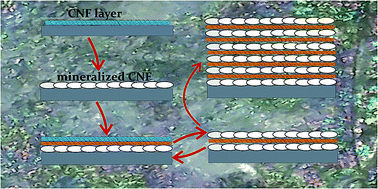
Nacre continues to be an inspiration for the fabrication of strong and tough materials from renewable and earth-abundant raw materials. Herein, we showed how a nacre-like hybrid material based on nanocellulose (NC) and CaCO3 can be prepared via the sequential infiltration of polymer-stabilised CaCO3 liquid precursors into layers of pre-deposited NC films. Layer-by-layer assembly of the NC films followed by controlled spreading and infiltration with liquid CaCO3 precursors generated a lamellar material with an architecture and iridescent appearance similar to those of nacre. The wettability of the NC films towards the liquid CaCO3 precursors was controlled by hydroxyl and carboxyl functionalization of the NC fibrils and the addition of magnesium ions. The combination of a high stiffness and plasticity of the nacre-like NC/CaCO3 hybrid materials show that excellent mechanical properties can be obtained employing a fibrillar organic constituent that is relatively hard. The fabrication of a nacre-like hybrid material via an aqueous route of assembly and infiltration processing demonstrates how a sustainable composite material with outstanding properties can be produced using the most abundant biopolymer and biomineral on earth.