Sajjad Ahangar Zonouzi, Rahmatollah Khodabandeh, Habibollah Safarzadeh, HabibAminfar, Yuliya Trushkina, Mousa Mohammadpourfard, Morteza Ghanbarpour, German Salazar-Alvarez
Experimental Thermal and Fluid Science (2017) In press
DOI: 10.1016/j.expthermflusci.2017.10.013
Abstract:
In this paper, the effects of applying magnetic field on hydrodynamics and heat transfer of Fe3O4/water magnetic nanofluid flowing inside a vertical tube have been studied experimentally. The applied magnetic field was resulted from quadrupole magnets located at different axial positions along the tube length. The variations of the local heat transfer coefficient and also the pressure drop of the ferrofluid flow along the length of the tube by applying the magnetic quadrupole field have been investigated for different Reynolds numbers. The obtained experimental results show maximum enhancements of 23.4%, 37.9% and 48.9% in the local heat transfer coefficient for the magnetic nanofluid with 2 vol.% Fe3O4 in the presence of the quadrupole magnets located at three different axial installation positions for the Reynold number of 580 and the relative increase in total pressure drop by applying the magnetic field is about 1% for Re=580. The increase of the heat transfer coefficient is due to the radial magnetic force toward the heated wall generated by magnetic quadrupole field acting over the ferrofluid flowing inside the tube so that the velocity of the ferrofluid in the vicinity of the heated wall is increased. It is also observed that the enhancement of heat transfer coefficient by applying magnetic quadrupole is decreased with increasing the Reynolds number.
Showing posts with label iron oxide. Show all posts
Showing posts with label iron oxide. Show all posts
2017-11-02

2017-07-18
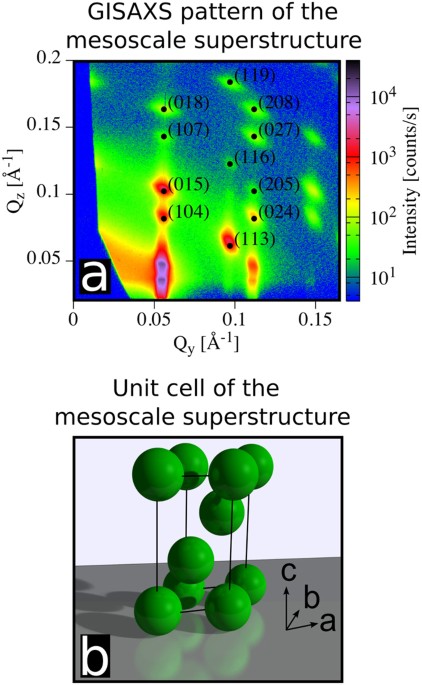
[OPEN ACCESS] Superlattice growth and rearrangement during evaporation-induced nanoparticle self-assembly
Elisabeth Josten*, Erik Wetterskog, Artur Glavic, Peter Boesecke, Artem Feoktystov, Elke Brauweiler-Reuters, Ulrich Rücker, German Salazar-Alvarez, Thomas Brückel & Lennart Bergström
Scientific Reports 7 (2017) 2802
DOI: 10.1038/s41598-017-02121-4
Abstract:
Understanding the assembly of nanoparticles into superlattices with well-defined morphology and structure is technologically important but challenging as it requires novel combinations of in-situ methods with suitable spatial and temporal resolution. In this study, we have followed evaporation-induced assembly during drop casting of superparamagnetic, oleate-capped γ-Fe2O3 nanospheres dispersed in toluene in real time with Grazing Incidence Small Angle X-ray Scattering (GISAXS) in combination with droplet height measurements and direct observation of the dispersion. The scattering data was evaluated with a novel method that yielded time-dependent information of the relative ratio of ordered (coherent) and disordered particles (incoherent scattering intensities), superlattice tilt angles, lattice constants, and lattice constant distributions. We find that the onset of superlattice growth in the drying drop is associated with the movement of a drying front across the surface of the droplet. We couple the rapid formation of large, highly ordered superlattices to the capillary-induced fluid flow. Further evaporation of interstitital solvent results in a slow contraction of the superlattice. The distribution of lattice parameters and tilt angles was significantly larger for superlattices prepared by fast evaporation compared to slow evaporation of the solvent.
Scientific Reports 7 (2017) 2802
DOI: 10.1038/s41598-017-02121-4
Abstract:
Understanding the assembly of nanoparticles into superlattices with well-defined morphology and structure is technologically important but challenging as it requires novel combinations of in-situ methods with suitable spatial and temporal resolution. In this study, we have followed evaporation-induced assembly during drop casting of superparamagnetic, oleate-capped γ-Fe2O3 nanospheres dispersed in toluene in real time with Grazing Incidence Small Angle X-ray Scattering (GISAXS) in combination with droplet height measurements and direct observation of the dispersion. The scattering data was evaluated with a novel method that yielded time-dependent information of the relative ratio of ordered (coherent) and disordered particles (incoherent scattering intensities), superlattice tilt angles, lattice constants, and lattice constant distributions. We find that the onset of superlattice growth in the drying drop is associated with the movement of a drying front across the surface of the droplet. We couple the rapid formation of large, highly ordered superlattices to the capillary-induced fluid flow. Further evaporation of interstitital solvent results in a slow contraction of the superlattice. The distribution of lattice parameters and tilt angles was significantly larger for superlattices prepared by fast evaporation compared to slow evaporation of the solvent.
2017-03-11
High-performance magnetic activated carbon from solid waste from lignin conversion processes. Part I: Their use as adsorbents for CO2
Wenming Hao, Fredrik Björnerbäck, Yulia Trushkina, Mikel Oregui-Bengoechea, German Salazar-Alvarez, Tanja Barth, and Niklas Hedin
ACS Sustainable Chem. Eng., (2017)
DOI: 10.1021/acssuschemeng.6b02795
Abstract:
Lignin is naturally abundant and a renewable precursor with a potential to be used in the production of both chemicals and materials. As many lignin conversion processes suffer from a significant production of solid wastes in the form of hydrochars, this study focused on transforming hydrochars into magnetic activated carbons (MAC). The hydrochars were produced via hydrothermal treatment of lignins together with formic acid. The activation of the hydrochars was performed chemically with KOH with a focus on the optimization of the MACs as adsorbents for CO2. MACs are potentially relevant to carbon capture and storage (CCS) and gas purification processes. In general, the MACs had high specific surface areas (up to 2875 m2/g), high specific pore volumes, and CO2 adsorption capacities of up to 6.0 mmol/g (1 atm, 0 °C). The textual properties of the MACs depended on the temperature of the activation. MACs activated at a temperature of 700 °C had very high ultramicropore volumes, which are relevant for potential adsorption-driven separation of CO2 from N2. Activation at 800 °C led to MACs with larger pores and very high specific surface areas. This temperature-dependent optimization option, combined with the magnetic properties, provided numerous potential applications of the MACs besides of CCS. The hydrochar derived from eucalyptus lignin, and the corresponding MACs displayed soft magnetic behavior with coercivities of < 100 Oe and saturation magnetization values of 1-10 emu/g.

ACS Sustainable Chem. Eng., (2017)
DOI: 10.1021/acssuschemeng.6b02795
Abstract:
Lignin is naturally abundant and a renewable precursor with a potential to be used in the production of both chemicals and materials. As many lignin conversion processes suffer from a significant production of solid wastes in the form of hydrochars, this study focused on transforming hydrochars into magnetic activated carbons (MAC). The hydrochars were produced via hydrothermal treatment of lignins together with formic acid. The activation of the hydrochars was performed chemically with KOH with a focus on the optimization of the MACs as adsorbents for CO2. MACs are potentially relevant to carbon capture and storage (CCS) and gas purification processes. In general, the MACs had high specific surface areas (up to 2875 m2/g), high specific pore volumes, and CO2 adsorption capacities of up to 6.0 mmol/g (1 atm, 0 °C). The textual properties of the MACs depended on the temperature of the activation. MACs activated at a temperature of 700 °C had very high ultramicropore volumes, which are relevant for potential adsorption-driven separation of CO2 from N2. Activation at 800 °C led to MACs with larger pores and very high specific surface areas. This temperature-dependent optimization option, combined with the magnetic properties, provided numerous potential applications of the MACs besides of CCS. The hydrochar derived from eucalyptus lignin, and the corresponding MACs displayed soft magnetic behavior with coercivities of < 100 Oe and saturation magnetization values of 1-10 emu/g.
2016-10-28
Following in real-time the two-step assembly of nanoparticles into mesocrystals in levitating drops
Michael Agthe, Tomás S. Plivelic, Ana Labrador, Lennart Bergström, German Salazar-Alvarez

Nano Letters (2016)
Abstract:
Mesocrystals composed of crystallographically-aligned nanocrystals are present in biominerals and assembled materials which show strongly directional properties of importance for mechanical protection and functional devices. Mesocrystals are commonly formed by complex biomineralisation processes and can also be generated by assembly of anisotropic nanocrystals. Here, we follow the evaporation-induced assembly of maghemite nanocubes into mesocrystals in real-time in levitating drops. Analysis of time-resolved small angle X-ray scattering data and ex-situ scanning electron microscopy together with interparticle potential calculations show that the substrate-free, particle-mediated crystallization process proceeds in two stages involving the formation and rapid transformation of a dense, structurally disordered phase into ordered mesocrystals. Controlling and tailoring the particle-mediated formation of mesocrystals could be utilized to assemble designed nanoparticles into new materials with unique functions.

2016-07-13
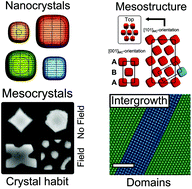
[OPEN ACCESS] Tuning the structure and habit of iron oxide mesocrystals
Erik Wetterskog*, Alice Klapper, Sabrina Disch, Elisabeth Josten, Raphaël P. Hermann, Ulrich Rücker, Thomas Brückel, Lennart Bergström and German Salazar-Alvarez*
Nanoscale (2016)
DOI: 10.1039/C6NR03776C
Abstract:
A precise control over the meso- and microstructure of ordered and aligned nanoparticle assemblies, i.e., mesocrystals, is essential in the quest of exploiting collective material properties for potential applications. In this work, we produce evaporation-induced self-assembled mesocrystals with different mesostructures and crystal habits based on iron oxide nanocubes by varying the nanocube size and shape, and by applying magnetic fields. A full 3D characterization of the mesocrystals was performed using image analysis, high-resolution scanning electron microscopy and Grazing Incidence Small Angle X-ray Scattering (GISAXS). This enabled structural determination of e.g. multi-domain mesocrystals with complex crystal habits, and the quantification of interparticle distances with sub-nm precision. Mesocrystals of small nanocubes (l = 8.6 – 12.6 nm) are isostructural with a body centred tetragonal (bct) lattice whereas assembly of the largest nanocubes in this study (l = 13.6 nm) additionally form a simple cubic (sc) lattice. The mesocrystal habit can be tuned from a square, hexagonal to star-like and pillar shapes depending on the particle size, shape, and the strength of the applied magnetic field. Finally, we outline a qualitative phase diagram of the evaporation-induced self-assembled superparamagnetic iron oxide nanocube mesocrystals based on nanocube edge length and magnetic field strength.
Nanoscale (2016)
DOI: 10.1039/C6NR03776C
Abstract:
A precise control over the meso- and microstructure of ordered and aligned nanoparticle assemblies, i.e., mesocrystals, is essential in the quest of exploiting collective material properties for potential applications. In this work, we produce evaporation-induced self-assembled mesocrystals with different mesostructures and crystal habits based on iron oxide nanocubes by varying the nanocube size and shape, and by applying magnetic fields. A full 3D characterization of the mesocrystals was performed using image analysis, high-resolution scanning electron microscopy and Grazing Incidence Small Angle X-ray Scattering (GISAXS). This enabled structural determination of e.g. multi-domain mesocrystals with complex crystal habits, and the quantification of interparticle distances with sub-nm precision. Mesocrystals of small nanocubes (l = 8.6 – 12.6 nm) are isostructural with a body centred tetragonal (bct) lattice whereas assembly of the largest nanocubes in this study (l = 13.6 nm) additionally form a simple cubic (sc) lattice. The mesocrystal habit can be tuned from a square, hexagonal to star-like and pillar shapes depending on the particle size, shape, and the strength of the applied magnetic field. Finally, we outline a qualitative phase diagram of the evaporation-induced self-assembled superparamagnetic iron oxide nanocube mesocrystals based on nanocube edge length and magnetic field strength.
2016-07-09
3D visualization of iron oxidation state in FeO/Fe3O4 core-shell nanocubes from electron energy loss tomography
Pau Torruella, Raul Arenal, Francisco de la Peña*, Zineb Saghi, Lluís Yedra, Alberto Eljarrat, Lluis Lopez-Conesa, Marta Estrader*, Alberto López-Ortega, German Salazar-Alvarez, Josep Nogués Sanmiquel, Caterina Ducati, Paul A. Midgley, Francesca Peiró, and Sonia Estrade*
Nano Letters, 16 (2016) 5068-5073
DOI: 10.1021/acs.nanolett.6b01922

Abstract:
The physicochemical properties used in numerous advanced nanostructured devices are directly controlled by the oxidation states of their constituents. In this work we combine electron energy-loss spectroscopy, blind source separation, and computed tomography to reconstruct in three dimensions the distribution of Fe2+ and Fe3+ ions in a FeO/Fe3O4 core/shell cube-shaped nanoparticle with nanometric resolution. The results highlight the sharpness of the interface between both oxides and provide an average shell thickness, core volume, and average cube edge length measurements in agreement with the magnetic characterization of the sample.

Abstract:
The physicochemical properties used in numerous advanced nanostructured devices are directly controlled by the oxidation states of their constituents. In this work we combine electron energy-loss spectroscopy, blind source separation, and computed tomography to reconstruct in three dimensions the distribution of Fe2+ and Fe3+ ions in a FeO/Fe3O4 core/shell cube-shaped nanoparticle with nanometric resolution. The results highlight the sharpness of the interface between both oxides and provide an average shell thickness, core volume, and average cube edge length measurements in agreement with the magnetic characterization of the sample.
2016-01-11
Thin Water Films at Multifaceted Hematite Particle Surfaces
Jean-François Boily, Merve Yeşilbaş, Munshi Md. Musleh Uddin, Lu Baiqing, Yulia Trushkina, and Germàn Salazar-Alvarez
Langmuir, 31 (2015) 13127–13137
DOI: 10.1021/acs.langmuir.5b03167
Abstract:
Mineral surfaces exposed to moist air stabilize nanometer- to micrometer-thick water films. This study resolves the nature of thin water film formation at multifaceted hematite (α-Fe2O3) nanoparticle surfaces with crystallographic faces resolved by selected area electron diffraction. Dynamic vapor adsorption (DVA) in the 0–19 Torr range at 298 K showed that these particles stabilize water films consisting of up to 4–5 monolayers. Modeling of these data predicts water loadings in terms of an “adsorption regime” (up to 16 H2O/nm2) involving direct water binding to hematite surface sites, and of a “condensation regime” (up to 34 H2O/nm2) involving water binding to hematite-bound water nanoclusters. Vibration spectroscopy identified the predominant hematite surface hydroxo groups (−OH, μ–OH, μ3–OH) through which first layer water molecules formed hydrogen bonds, as well as surface iron sites directly coordinating water molecules (i.e., as geminal η–(OH2)2 sites). Chemometric analyses of the vibration spectra also revealed a strong correspondence in the response of hematite surface hydroxo groups to DVA-derived water loadings. These findings point to a near-saturation of the hydrogen-bonding environment of surface hydroxo groups at a partial water vapor pressure of ∼8 Torr (∼40% relative humidity). Classical molecular dynamics (MD) resolved the interfacial water structures and hydrogen bonding populations at five representative crystallographic faces expressed in these nanoparticles. Simulations of single oriented slabs underscored the individual roles of all (hydro)oxo groups in donating and accepting hydrogen bonds with first layer water in the “adsorption regime”. These analyses pointed to the preponderance of hydrogen bond-donating −OH groups in the stabilization of thin water films. Contributions of μ–OH and μ3–OH groups are secondary, yet remain essential in the stabilization of thin water films. MD simulations also helped resolve crystallographic controls on water–water interactions occurring in the “condensation regime”. Water–water hydrogen bond populations are greatest on the (001) face, and decrease in importance in the order (001) > (012) ≈ (110) > (014) ≫ (100). Simulations of a single (∼5 nm × ∼ 6 nm × ∼ 6 nm) nanometric hematite particle terminated by the (001), (110), (012), and (100) faces also highlighted the key roles that sites at particle edges play in interconnecting thin water films grown along contiguous crystallographic faces. Hydroxo–water hydrogen bond populations showed that edges were the preferential loci of binding. These simulations also suggested that equilibration times for water binding at edges were slower than on crystallographic faces. In this regard, edges, and by extension roughened surfaces, are expected to play commanding roles in the stabilization of thin water films. Thus, in focusing on the properties of nanometric-thick water layers at hematite surfaces, this study revealed the nature of interactions between water and multifaced particle surfaces. Our results pave the way for furthering our understanding of mineral-thin water film interfacial structure and reactivity on a broader range of materials.

Langmuir, 31 (2015) 13127–13137
DOI: 10.1021/acs.langmuir.5b03167
Abstract:
Mineral surfaces exposed to moist air stabilize nanometer- to micrometer-thick water films. This study resolves the nature of thin water film formation at multifaceted hematite (α-Fe2O3) nanoparticle surfaces with crystallographic faces resolved by selected area electron diffraction. Dynamic vapor adsorption (DVA) in the 0–19 Torr range at 298 K showed that these particles stabilize water films consisting of up to 4–5 monolayers. Modeling of these data predicts water loadings in terms of an “adsorption regime” (up to 16 H2O/nm2) involving direct water binding to hematite surface sites, and of a “condensation regime” (up to 34 H2O/nm2) involving water binding to hematite-bound water nanoclusters. Vibration spectroscopy identified the predominant hematite surface hydroxo groups (−OH, μ–OH, μ3–OH) through which first layer water molecules formed hydrogen bonds, as well as surface iron sites directly coordinating water molecules (i.e., as geminal η–(OH2)2 sites). Chemometric analyses of the vibration spectra also revealed a strong correspondence in the response of hematite surface hydroxo groups to DVA-derived water loadings. These findings point to a near-saturation of the hydrogen-bonding environment of surface hydroxo groups at a partial water vapor pressure of ∼8 Torr (∼40% relative humidity). Classical molecular dynamics (MD) resolved the interfacial water structures and hydrogen bonding populations at five representative crystallographic faces expressed in these nanoparticles. Simulations of single oriented slabs underscored the individual roles of all (hydro)oxo groups in donating and accepting hydrogen bonds with first layer water in the “adsorption regime”. These analyses pointed to the preponderance of hydrogen bond-donating −OH groups in the stabilization of thin water films. Contributions of μ–OH and μ3–OH groups are secondary, yet remain essential in the stabilization of thin water films. MD simulations also helped resolve crystallographic controls on water–water interactions occurring in the “condensation regime”. Water–water hydrogen bond populations are greatest on the (001) face, and decrease in importance in the order (001) > (012) ≈ (110) > (014) ≫ (100). Simulations of a single (∼5 nm × ∼ 6 nm × ∼ 6 nm) nanometric hematite particle terminated by the (001), (110), (012), and (100) faces also highlighted the key roles that sites at particle edges play in interconnecting thin water films grown along contiguous crystallographic faces. Hydroxo–water hydrogen bond populations showed that edges were the preferential loci of binding. These simulations also suggested that equilibration times for water binding at edges were slower than on crystallographic faces. In this regard, edges, and by extension roughened surfaces, are expected to play commanding roles in the stabilization of thin water films. Thus, in focusing on the properties of nanometric-thick water layers at hematite surfaces, this study revealed the nature of interactions between water and multifaced particle surfaces. Our results pave the way for furthering our understanding of mineral-thin water film interfacial structure and reactivity on a broader range of materials.

2015-01-07
[OPEN ACCESS] Origin of the Large Dispersion of Magnetic Properties in Nanostructured Oxides: FexO/Fe3O4 Nanoparticles as a Case Study
M. Estrader, A. López-Ortega, I. V. Golosovsky, S. Estradé, G. Salazar-Alvarez, Ll. López- Conesa, D. Tobia, E. Winkler, J. D. Ardisson, W.A.A. Macedo, M. Vasilakaki, K. N. Trohidou, R. D. Zysler, F. Peiró, L. Bergström, and J. Nogués
Nanoscale (2015)
DOI: 10.1039/C4NR06351A
Abstract:
The intimate relationship in transition-metal oxides between stoichiometry and physiochemical properties makes them appealing as tunable materials. These features become exacerbated when dealing with nanostructures. However, due to the complexity of nanoscale materials, establishing a distinct relationship between structure-morphology and functionalities is often complicated. In this regard, in the FexO/Fe3O4 system a largely unexplained broad dispersion of magnetic properties has been observed. Here we show, thanks to a comprehensive multi-technique approach, a clear correlation between magneto-structural properties in large (45 nm) and small (9 nm) FexO/Fe3O4 core/shell nanoparticles that can explain the spread of magnetic behaviors. The results reveal that while the FexO core in the large nanoparticles is antiferromagnetic and has bulk-like stoichiometry and unit-cell parameters, the FexO core in the small particles is highly non-stoichiometric and strained, displaying no significant antiferromagnetism. These results highlight the importance of ample characterization to fully understand the properties of nanostructured metal oxides.

2014-07-30
Oriented aggregation of lepidocrocite and impact on surface charge development
Philipp A. Kozin, German Salazar-Alvarez, and Jean-François Boily
Langmuir 30 (2014) 9017–9021
Langmuir 30 (2014) 9017–9021
DOI: 10.1021/la500507e
Abstract
The impact of lepidocrocite (γ-FeOOH) nanoparticle aggregation on mineral surface charge development was resolved in aqueous solutions of NaCl and NaClO4. Synthetic rod-like particles exhibiting charged edge (100) and neutrally/low-charged (010) faces self-aggregated in salt-free solutions. Aggregation was notably imaged by high-resolution transmission electron microscopy, and inferred by decreases in N2(g)-B.E.T. specific surface area from 94 m2/g to 77 m2/g after 12 months, and to 66 m2/g after 33 months storage. Potential determining (H+, OH–) ions loadings in the 4–11 pH range were unchanged only if the particles remained aggregated in NaCl but only if they were disaggregated in NaClO4. These differences, alongside molecular simulations and experimental ion loadings resolved in other studies from our group, point to important controls on background electrolyte ion identity on the aggregation and charge development in lepidocrocite. These results may apply further to other mineral surfaces of comparable surface (hydr)oxo populations.

2014-02-10
Spin excitations in cubic maghemite nanoparticles studied by time-of-flight neutron spectroscopy
Phys. Rev. B 89, 064402 (2014)
DOI: 10.1103/PhysRevB.89.064402
S. Disch, R. P. Hermann, E. Wetterskog, A. A. Podlesnyak, K. An, T. Hyeon, G. Salazar-Alvarez, L. Bergström, and Th. Brückel
Abstract:
We have determined the field dependence of collective magnetic excitations in iron oxide nanoparticles of cubic shape with 8.42(2) nm edge length and a narrow log normal size distribution of 8.2(2)% using time-of-flight neutron spectroscopy. The energy dependence of the uniform precession modes was investigated up to 5 T applied field and yields a Landé factor g=2.05(2) as expected for maghemite (γ-Fe2O3) nanoparticles. A large effective anisotropy field of BA,eff=0.45(16) T was determined, in excellent agreement with macroscopic measurements. This anisotropy is attributed to enhanced shape anisotropy in these monodisperse cubic nanoparticles. The combination of our results with macroscopic magnetization information provides a consistent view of the energy scales of superparamagnetic relaxation and collective magnetic excitations in magnetic nanoparticles.
DOI: 10.1103/PhysRevB.89.064402
S. Disch, R. P. Hermann, E. Wetterskog, A. A. Podlesnyak, K. An, T. Hyeon, G. Salazar-Alvarez, L. Bergström, and Th. Brückel
Abstract:
We have determined the field dependence of collective magnetic excitations in iron oxide nanoparticles of cubic shape with 8.42(2) nm edge length and a narrow log normal size distribution of 8.2(2)% using time-of-flight neutron spectroscopy. The energy dependence of the uniform precession modes was investigated up to 5 T applied field and yields a Landé factor g=2.05(2) as expected for maghemite (γ-Fe2O3) nanoparticles. A large effective anisotropy field of BA,eff=0.45(16) T was determined, in excellent agreement with macroscopic measurements. This anisotropy is attributed to enhanced shape anisotropy in these monodisperse cubic nanoparticles. The combination of our results with macroscopic magnetization information provides a consistent view of the energy scales of superparamagnetic relaxation and collective magnetic excitations in magnetic nanoparticles.
2013-12-17
Robust antiferromagnetic coupling in hard-soft bi-magnetic core/shell nanoparticles
Nature Communications 4 (2013) 2960.
M. Estrader, A. López-Ortega, S. Estradé, I. V. Golosovsky, G. Salazar-Alvarez, M. Vasilakaki, K. N. Trohidou, M. Varela, D. C. Stanley, M. Sinko, M. J. Pechan, D. J. Keavney, F. Peiró, S. Suriñach, M. D. Baró & J. Nogués

Abstract:
The growing miniaturization demand of magnetic devices is fuelling the recent interest in bi-magnetic nanoparticles as ultimate small components. One of the main goals has been to reproduce practical magnetic properties observed so far in layered systems. In this context, although useful effects such as exchange bias or spring magnets have been demonstrated in core/shell nanoparticles, other interesting key properties for devices remain elusive. Here we show a robust antiferromagnetic (AFM) coupling in core/shell nanoparticles which, in turn, leads to the foremost elucidation of positive exchange bias in bi-magnetic hard-soft systems and the remarkable regulation of the resonance field and amplitude. The AFM coupling in iron oxide—manganese oxide based, soft/hard and hard/soft, core/shell nanoparticles is demonstrated by magnetometry, ferromagnetic resonance and X-ray magnetic circular dichroism. Monte Carlo simulations prove the consistency of the AFM coupling. This unique coupling could give rise to more advanced applications of bi-magnetic core/shell nanoparticles.
2013-10-31
[OPEN ACCESS] Dynamic growth modes of ordered arrays and mesocrystals during drop-casting of iron oxide nanocubes
Cryst. Eng. Comm. 2013
DOI: 10.1039/C3CE41871E
Michael Agthe, Erik Wetterskog, Johanne Mouzon, German Salazar-Alvarez and Lennart Bergström
Abstract:
The growth modes of self-assembled mesocrystals and ordered arrays from dispersions of iron oxide nanocubes with a mean edge length of 9.6 nm during controlled solvent removal have been investigated with a combination of visible light video microscopy, atomic force microscopy and scanning electron microscopy. Mesocrystals with translational and orientational order of sizes up to 10 μm are formed spontaneously during the final, diffusion-controlled, drop-casting stage when the liquid film is very thin and the particle concentration is high. Convection-driven deposition of ordered nanocube arrays at the edge of the drying droplet is a manifestation of the so called coffee-ring effect. Dendritic growth or fingering of rapidly growing arrays of ordered nanocubes could also be observed in a transition regime as the growth front moves from the initial three-phase contact line towards the centre of the original droplet.
Video abstract:
Cover page:
http://pubs.rsc.org.ezp.sub.su.se/en/content/articlepdf/2014/ce/c4ce90010c?page=search
DOI: 10.1039/C3CE41871E
Michael Agthe, Erik Wetterskog, Johanne Mouzon, German Salazar-Alvarez and Lennart Bergström

The growth modes of self-assembled mesocrystals and ordered arrays from dispersions of iron oxide nanocubes with a mean edge length of 9.6 nm during controlled solvent removal have been investigated with a combination of visible light video microscopy, atomic force microscopy and scanning electron microscopy. Mesocrystals with translational and orientational order of sizes up to 10 μm are formed spontaneously during the final, diffusion-controlled, drop-casting stage when the liquid film is very thin and the particle concentration is high. Convection-driven deposition of ordered nanocube arrays at the edge of the drying droplet is a manifestation of the so called coffee-ring effect. Dendritic growth or fingering of rapidly growing arrays of ordered nanocubes could also be observed in a transition regime as the growth front moves from the initial three-phase contact line towards the centre of the original droplet.
Video abstract:
Cover page:
http://pubs.rsc.org.ezp.sub.su.se/en/content/articlepdf/2014/ce/c4ce90010c?page=search
2013-08-05
[OPEN ACCESS] Anomalous Magnetic Properties of Nanoparticles Arising from Defect Structures: Topotaxial Oxidation of Fe1-xO|Fe3-δO4 Core|Shell Nanocubes to Single-Phase Particles
ACS Nano, 2013
DOI: 10.1021/nn402487q
Erik Wetterskog , Cheuk-Wai Tai , Jekabs Grins , Lennart Bergström, and German Salazar-Alvarez

Abstract:
Here we demonstrate that the anomalous magnetic properties of iron oxide nanoparticles are correlated with defects in their interior. We studied the evolution of microstructure and magnetic properties of biphasic core|shell Fe1-xO|Fe3-δO4 nanoparticles synthesized by thermal decomposition during their topotaxial oxidation to single-phase nanoparticles. Geometric phase analysis of high-resolution electron microscopy images reveals a large interfacial strain at the core|shell interface and the development of anti-phase boundaries. Dark-field transmission electron microscopy and powder x-ray diffraction concur that, as the oxidation proceeds, the interfacial strain is released as the Fe1-xO core is removed, but that the anti-phase boundaries remain. The anti-phase boundaries result in anomalous magnetic behavior, i.e., a reduced saturation magnetization and exchange bias effects in single-phase nanoparticles. Our results indicate that internal defects play an important role in dictating the magnetic properties of iron oxide nanoparticles.
2013-04-21
Correlating material-specific layers and magnetic distributions within onion-like Fe3O4/MnO/γ-Mn2O3 core/shell nanoparticles
J. Appl. Phys. 113, 17B531 (2013)
K. L. Krycka; J. A. Borchers; M. Laver; G. Salazar-Alvarez; A. López-Ortega; M. Estrader; S. Suriñach; M. D. Baró; J. Sort; J. Nogués
DOI: 10.1063/1.4801423
Abstract
The magnetic responses of two nanoparticle systems comprised of Fe3O4/γ-Mn2O3 (soft ferrimagnetic, FM/hard FM) and Fe3O4/MnO/γ-Mn2O3 (soft FM/antiferromagnetic, AFM/hard FM) are compared, where the MnO serves to physically decouple the FM layers. Variation in the temperature and applied field allows for Small Angle Neutron Scattering (SANS) measurements of the magnetic moments both parallel and perpendicular to an applied field. Data for the bilayer particle indicate that the graded ferrimagnetic layers are coupled and respond to the field as a single unit. For the trilayer nanoparticles, magnetometry suggests a Curie temperature (TC) ≈ 40 K for the outer γ-Mn2O3component, yet SANS reveals an increase in the magnetization associated with outer layer that is perpendicular to the applied field above TC during magnetic reversal. This result suggests that the γ-Mn2O3 magnetically reorients relative to the applied field as the temperature is increased above 40 K.
K. L. Krycka; J. A. Borchers; M. Laver; G. Salazar-Alvarez; A. López-Ortega; M. Estrader; S. Suriñach; M. D. Baró; J. Sort; J. Nogués
DOI: 10.1063/1.4801423
Abstract
The magnetic responses of two nanoparticle systems comprised of Fe3O4/γ-Mn2O3 (soft ferrimagnetic, FM/hard FM) and Fe3O4/MnO/γ-Mn2O3 (soft FM/antiferromagnetic, AFM/hard FM) are compared, where the MnO serves to physically decouple the FM layers. Variation in the temperature and applied field allows for Small Angle Neutron Scattering (SANS) measurements of the magnetic moments both parallel and perpendicular to an applied field. Data for the bilayer particle indicate that the graded ferrimagnetic layers are coupled and respond to the field as a single unit. For the trilayer nanoparticles, magnetometry suggests a Curie temperature (TC) ≈ 40 K for the outer γ-Mn2O3component, yet SANS reveals an increase in the magnetization associated with outer layer that is perpendicular to the applied field above TC during magnetic reversal. This result suggests that the γ-Mn2O3 magnetically reorients relative to the applied field as the temperature is increased above 40 K.
2013-03-05
[OPEN ACCESS] Structural diversity in iron oxide nanoparticle assemblies as directed by particle morphology and orientation
Nanoscale, 2013, Just Accepted Manuscript
Sabrina Disch, Erik Wetterskog, Raphaël P. Hermann, Denis Korolkov, Peter Busch, Peter Boesecke, Olivier Lyon, Ulla Vainio, German Salazar-Alvarez, Lennart Bergström and Thomas Brückel
DOI: 10.1039/C3NR33282A
Abstract:
The mesostructure of ordered arrays of anisotropic nanoparticles is controlled by a combination of packing constraints and interparticle interactions, two factors that are strongly dependent on the particle morphology. We have investigated how the degree of truncation of iron oxide nanocubes controls the mesostructure and particle orientation in drop cast mesocrystal arrays. The combination of grazing incidence small angle X-ray scattering and scanning electron microscopy shows that mesocrystals of highly truncated cubic nanoparticles assemble in an fcc-type mesostructure - similar to arrays formed by iron oxide nanospheres, but with a significantly reduced packing density and displaying two different growth orientations. Strong satellite reflections in the GISAXS pattern indicate a commensurate mesoscopic superstructure that is related to stacking faults in mesocrystals of the anisotropic nanocubes. Our results show how subtle variation in shape anisotropy can induce oriented arrangements of nanoparticles of different structures and also create mesoscopic superstructures of larger periodicity.
2013-01-10
Resolving Material-Specific Structures within Fe3O4|γ-Mn2O3 Core|Shell Nanoparticles Using Anomalous Small-Angle X-ray Scattering
ACS Nano 2013, 7, 921-931.
DOI: 10.1021/nn303600e

Abstract:
2012-12-03
[OPEN ACCESS] 2D to 3D crossover of the magnetic properties in ordered arrays of iron oxide nanocrystals - Nanoscale (RSC Publishing)
Nanoscale 5 (2013) 953-960.
Bertrand Faure , Erik Wetterskog , Klas Gunnarsson , Elisabeth Josten , Raphaël P. Hermann , Thomas Brückel , Jens Wenzel Andreasen , Florian Meneau , Mathias Meyer , Alexander P Lyubartsev , Lennart Bergström , German Salazar-Alvarez and Peter Svedlindh

DOI: 10.1039/C2NR33013JD
Abstract:
The magnetic 2D to 3D crossover behavior of well-ordered arrays of monodomain γ-Fe2O3 spherical nanoparticles with different thicknesses has been investigated by magnetometry and Monte Carlo (MC) simulations. Using structural information of the arrays obtained from grazing incidence small-angle X-ray scattering and scanning electron microscopy together with experimentally determined values for the saturation magnetization and magnetic anisotropy of the nanoparticles, we show that MC simulations can reproduce the thickness-dependent magnetic behavior. The magnetic dipolar particle interactions induce a ferromagnetic coupling that increases in strength with decreasing thickness of the array. The 2D to 3D transition in the magnetic properties is mainly driven by a change in the orientation of the magnetic vortex states with increasing thickness, becoming more isotropic as the thickness of the array increases. Magnetic anisotropy prevents long-range ferromagnetic order from being established at low temperature and the nanoparticle magnetic moments instead freeze along directions defined by the distribution of easy magnetization directions.2012-01-17
[OPEN ACCESS] Quantitative spatial magnetization distribution in iron oxide nanocubes and nanospheres by polarized small-angle neutron scattering
http://stacks.iop.org/1367-2630/14/013025 [OPEN ACCESS]
New Journal of Physics, 2012, 14, 013025
Sabrina Disch, Erik Wetterskog, Raphaël P. Hermann, Albrecht Wiedenmann, Ulla Vainio, German Salazar-Alvarez, Lennart Bergström and Thomas Brückel
DOI: 10.1088/1367-2630/14/1/013025

By means of polarized small-angle neutron scattering, we have resolved the long-standing challenge of determining the magnetization distribution in magnetic nanoparticles in absolute units. The reduced magnetization, localized in non-interacting nanoparticles, indicates strongly particle shape- dependent surface spin canting with a 0.3(1) and 0.5(1) nm thick surface shell of reduced magnetization found for ~9 nm nanospheres and ~8.5 nm nanocubes, respectively. Further, the reduced macroscopic magnetization in nanoparticles results not only from surface spin canting, but also from drastically reduced magnetization inside the uniformly magnetized core as compared to the bulk material. Our microscopic results explain the low macroscopic magnetization commonly found in nanoparticles.
2011-10-06
Two-, Three-, and Four-Component Magnetic Multilayer Onion Nanoparticles Based on Iron Oxides and Manganese Oxides
http://pubs.acs.org/doi/abs/10.1021/ja205810t
Journal of the American Chemical Society, 2011, 133, 16738–16741
Journal of the American Chemical Society, 2011, 133, 16738–16741
German Salazar-Alvarez, Hans Lidbaum, Alberto López-Ortega, Marta Estrader, Klaus Leifer, Jordi Sort, Santiago Suriñach, Maria Dolors Baró, and Josep Nogués
DOI: 10.1021/ja205810t

Magnetic multilayered, onion-like, heterostructured nanoparticles are interesting model systems for studying magnetic exchange coupling phenomena. In this work, we synthesized heterostructured magnetic nanoparticles composed of two, three, or four components using iron oxide seeds for the subsequent deposition of manganese oxide. The MnO layer was allowed either to passivate fully in air to form an outer layer of Mn3O4 or to oxidize partially to form MnO|Mn3O4 double layers. Through control of the degree of passivation of the seeds, particles with up to four different magnetic layers can be obtained (i.e., FeO|Fe3O4|MnO|Mn3O4). Magnetic characterization of the samples confirmed the presence of the different magnetic layers.
2011-09-21
Hamaker Constants of Iron Oxide Nanoparticles
http://pubs.acs.org/doi/abs/10.1021/la201387d

Langmuir, 2011, 27 (14), pp 8659–8664
Bertrand Faure, German Salazar-Alvarez, and Lennart Bergström
Bertrand Faure, German Salazar-Alvarez, and Lennart Bergström
DOI: 10.1021/la201387d

Abstract:
The Hamaker constants for iron oxide nanoparticles in various media have been calculated using Lifshitz theory. Expressions for the dielectric responses of three iron oxide phases (magnetite, maghemite, and hematite) were derived from recently published optical data. The nonretarded Hamaker constants for the iron oxide nanoparticles interacting across water, A1w1 = 33 – 39 zJ, correlate relatively well with previous reports, whereas the calculated values in nonpolar solvents (hexane and toluene), A131 = 9 – 29 zJ, are much lower than the previous estimates, particularly for magnetite. The magnitude of van der Waals interactions varies significantly between the studied phases (magnetite < maghemite < hematite), which highlights the importance of a thorough characterization of the particles. The contribution of magnetic dispersion interactions for particle sizes in the superparamagnetic regime was found to be negligible. Previous conjectures related to colloidal stability and self-assembly have been revisited on the basis of the new Lifshitz values of the Hamaker constants.
Subscribe to:
Posts (Atom)