Showing posts with label sustainable materials. Show all posts

2018-03-09

[OPEN POSITION]: PhD student in Materials Chemistry

PhD student in Materials Chemistry
at the Department of Materials and Environmental ChemistryClosing date: 24 April 2018.
The Department of Materials- and Environmental Chemistry (MMK) is one of the largest departments at the Faculty of Natural sciences with about 130 employees. The research activities of MMK are in the areas of Materials and Solid-state Chemistry focusing on different classes of materials; e.g. ceramics and glasses, self-assembled and porous materials, and soft matter. The work often encompasses synthesis, characterisation by X-ray diffraction and electron microscopy, NMR studies, modelling with computer simulations of materials with a potential for various applications. Environmental aspects are an important part of the research activities.
Project descriptionProject title: In-situ characterization of nanoparticles for electrocatalytic production of hydrogen.
Supervisor: Associate Prof. Germán Salazar-Alvarez, german.salazar.alvarez@mmk.su.se.
This PhD project will focus on the synthesis of catalytic nanomaterials for the partial oxidation of alcohols and their operando characterization using total scattering at synchrotron facilities and in-situ IR spectroscopy.
The target of the program is to develop efficient and selective catalysts through an effort involving theory, materials and electrocatalytic design and testing. The approach in the present project is in particular to fabricate and characterize nanomaterials to partially oxidize excess glycerol from biofuel production and waste carbohydrates from wood-based Kraft pulp processes to produce valuable chemicals and hydrogen. This PhD project is part of the program Materials for energy applications funded by the Swedish Foundation for Strategic Research (SSF). The project will be carried out in close collaboration within the project consortium consisting of researchers from KTH and SU and a couple of Swedish enterprises. A considerable part of the experiments will be carried out at synchrotron facilities around the world, primarily in Hamburg.
The successful candidate should have a background in chemistry or materials science with an interest in nanoparticle synthesis and in utilizing characterization methods such X-ray diffraction with Rietveld analysis. Experience in PDF analysis of nanomaterials and other related synchrotron techniques is advantageous. Knowledge of IR spectroscopy and TEM is meritorious but not a requirement.
More details on requirements and how to apply at 

[OPEN POSITION]: PhD student in Inorganic Chemistry

PhD student in Inorganic Chemistry

at the Department of Materials and Environmental Chemistry. Closing date: 24 April 2018.
The Department of Materials- and Environmental Chemistry (MMK) is one of the largest departments at the Faculty of Natural sciences with about 130 employees. The research activities of MMK are in the areas of Materials and Solid-state Chemistry focusing on different classes of materials; e.g. ceramics and glasses, self-assembled and porous materials, and soft matter. The work often encompasses synthesis, characterisation by X-ray diffraction and electron microscopy, NMR studies, modelling with computer simulations of materials with a potential for various applications. Environmental aspects are important for the research activities.
Project descriptionProject title: Synthesis and characterization of nanoparticles for electrocatalytic production of hydrogen.
Supervisor: Professor Mats Johnsson, mats.johnsson@mmk.su.se.
The project will focus on synthesis and characterization of nanoparticles aimed as electrocatalysts for hydrogen production based on excess glycerol from biofuel production and waste carbohydrates from wood-based Kraft pulp processes.
Many research projects aiming at hydrogen production focus on water splitting. The water oxidation reaction is associated with high anodic potentials due to unfavorable thermodynamics and slow reaction kinetics. Oxygen is a by-product from hydrogen production from water and is normally just released into the atmosphere. The approach in the present project is to replace the anodic reaction with partial oxidation of alcohols that results in a large decrease in electrical energy demand for hydrogen evolution and also valuable anodic products. This PhD project is part of the program Materials for energy applications funded by the foundation for strategic research (SSF). The project group consists of researchers from KTH and SU and the PhD student will also interact with Swedish enterprises. The target of the program is development of efficient and selective catalysts through an effort involving theory, materials and electrocatalytic design and testing.
The successful candidate should have a background in chemistry or materials science with an interest in synthetic inorganic chemistry and in utilizing several characterization methods such as SEM-EDS, TEM, Powder X-ray diffraction, and electrochemical measurements. Knowledge of those methods is a plus although not strictly required.
More info on requirements and how to apply at:

2017-03-16

[OPEN ACCESS] A CaCO3/nanocellulose-based bioinspired nacre-like material

Masoud Farhadi-Khouzani, Christina Schütz, Grażyna M. Durak, Jordina Fornell, Jordi Sort, Germán Salazar-Alvarez, Lennart Bergström and Denis Gebauer*

J. Mater. Chem. A, (2017)
DOI:10.1039/C6TA09524K

Abstract:
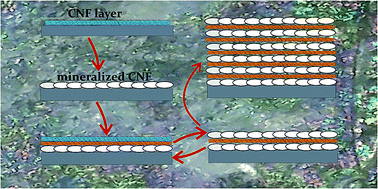
Nacre continues to be an inspiration for the fabrication of strong and tough materials from renewable and earth-abundant raw materials. Herein, we showed how a nacre-like hybrid material based on nanocellulose (NC) and CaCO3 can be prepared via the sequential infiltration of polymer-stabilised CaCO3 liquid precursors into layers of pre-deposited NC films. Layer-by-layer assembly of the NC films followed by controlled spreading and infiltration with liquid CaCO3 precursors generated a lamellar material with an architecture and iridescent appearance similar to those of nacre. The wettability of the NC films towards the liquid CaCO3 precursors was controlled by hydroxyl and carboxyl functionalization of the NC fibrils and the addition of magnesium ions. The combination of a high stiffness and plasticity of the nacre-like NC/CaCO3 hybrid materials show that excellent mechanical properties can be obtained employing a fibrillar organic constituent that is relatively hard. The fabrication of a nacre-like hybrid material via an aqueous route of assembly and infiltration processing demonstrates how a sustainable composite material with outstanding properties can be produced using the most abundant biopolymer and biomineral on earth.


2014-11-03

Thermally insulating and fire-retardant lightweight anisotropic foams based on nanocellulose and graphene oxide

Bernd Wicklein, Andraž Kocjan, German Salazar-Alvarez, Federico Carosio, Giovanni Camino, Markus Antonietti, and Lennart Bergström

Nature Nanotechnology 10 (2015) 277–283
DOI:10.1038/nnano.2014.248

Abstract
High-performance thermally insulating materials from renewable resources are needed to improve the energy efficiency of buildings. Traditional fossil-fuel-derived insulation materials such as expanded polystyrene and polyurethane have thermal conductivities that are too high for retrofitting or for building new, surface-efficient passive houses. Tailored materials such as aerogels and vacuum insulating panels are fragile and susceptible to perforation. Here, we show that freeze-casting suspensions of cellulose nanofibres, graphene oxide and sepiolite nanorods produces super-insulating, fire-retardant and strong anisotropic foams that perform better than traditional polymer-based insulating materials. The foams are ultralight, show excellent combustion resistance and exhibit a thermal conductivity of 15 mW/m·K, which is about half that of expanded polystyrene. At 30 °C and 85% relative humidity, the foams retained more than half of their initial strength. Our results show that nanoscale engineering is a promising strategy for producing foams with excellent properties using cellulose and other renewable nanosized fibrous materials.