Elisabeth Josten*, Erik Wetterskog, Artur Glavic, Peter Boesecke, Artem Feoktystov, Elke Brauweiler-Reuters, Ulrich Rücker, German Salazar-Alvarez, Thomas Brückel & Lennart Bergström
Scientific Reports 7 (2017) 2802
DOI: 10.1038/s41598-017-02121-4
Abstract:
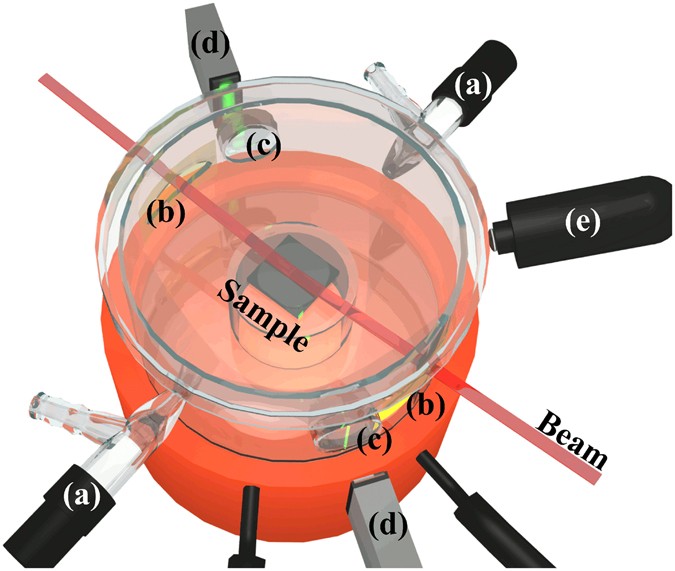
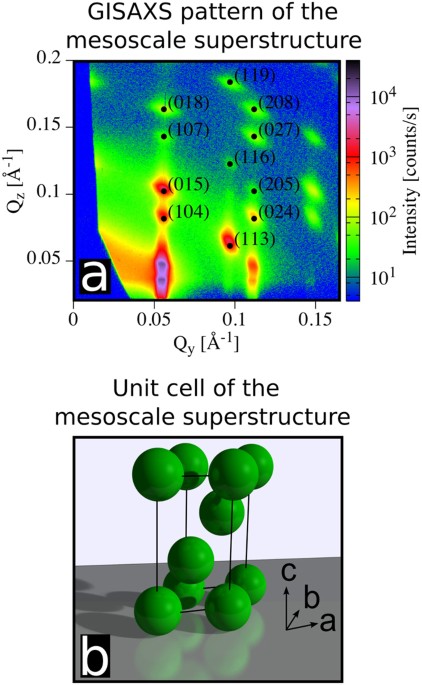
Understanding the assembly of nanoparticles into superlattices with well-defined morphology and structure is technologically important but challenging as it requires novel combinations of in-situ methods with suitable spatial and temporal resolution. In this study, we have followed evaporation-induced assembly during drop casting of superparamagnetic, oleate-capped γ-Fe2O3 nanospheres dispersed in toluene in real time with Grazing Incidence Small Angle X-ray Scattering (GISAXS) in combination with droplet height measurements and direct observation of the dispersion. The scattering data was evaluated with a novel method that yielded time-dependent information of the relative ratio of ordered (coherent) and disordered particles (incoherent scattering intensities), superlattice tilt angles, lattice constants, and lattice constant distributions. We find that the onset of superlattice growth in the drying drop is associated with the movement of a drying front across the surface of the droplet. We couple the rapid formation of large, highly ordered superlattices to the capillary-induced fluid flow. Further evaporation of interstitital solvent results in a slow contraction of the superlattice. The distribution of lattice parameters and tilt angles was significantly larger for superlattices prepared by fast evaporation compared to slow evaporation of the solvent.
Showing posts with label self-assembly. Show all posts
2017-07-18
2015-05-15
[PhD defence] Christina Schütz – Fabrication of nanocellulose-based materials - Liquid crystalline phase formation and design of inorganic–nanocellulose hybrids
2014-11-02
[OPEN ACCESS] Precise control over shape and size of iron oxide nanocrystals suitable for assembly into ordered particle arrays
Erik Wetterskog, Michael Agthe, Arnaud Mayence, Jekabs Grins, Dong Wang, Subhasis Rana, Anwar Ahniyaz, German Salazar-Alvarez and Lennart Bergström
Sci. Technol. Adv. Mater. 15 (2014) 055010
DOI:10.1088/1468-6996/15/5/055010
Abstract
Here we demonstrate how monodisperse iron oxide nanocubes and nanospheres with average sizes between 5 and 27 nm can be synthesized by thermal decomposition. The relative importance of the purity of the reactants, the ratio of oleic acid and sodium oleate, the maximum temperature, and the rate of temperature increase, on robust and reproducible size and shape-selective iron oxide nanoparticle synthesis are identified and discussed. The synthesis conditions that generate highly monodisperse iron oxide nanocubes suitable for producing large ordered arrays, or mesocrystals are described in detail.
Sci. Technol. Adv. Mater. 15 (2014) 055010
DOI:10.1088/1468-6996/15/5/055010
Abstract
Here we demonstrate how monodisperse iron oxide nanocubes and nanospheres with average sizes between 5 and 27 nm can be synthesized by thermal decomposition. The relative importance of the purity of the reactants, the ratio of oleic acid and sodium oleate, the maximum temperature, and the rate of temperature increase, on robust and reproducible size and shape-selective iron oxide nanoparticle synthesis are identified and discussed. The synthesis conditions that generate highly monodisperse iron oxide nanocubes suitable for producing large ordered arrays, or mesocrystals are described in detail.
2014-09-22
[OPEN ACCESS] Probing planar defects in nanoparticle superlattices by 3D small-angle electron diffraction tomography and real space imaging
Arnaud Mayence, Dong Wang, German Salazar-Alvarez, Peter Oleynikov and Lennart Bergström
Nanoscale, 2014, Accepted Manuscript
DOI: 10.1039/C4NR04156A
Abstract
We demonstrate how the acquisition and processing of 3D electron diffraction data can be extended to characterize structural features on the mesoscale, and show how lattice distortions in superlattices of self-assembled spherical Pd nanoparticles can be quantified using small-angle electron diffraction tomography (3D SA-EDT). Transmission electron microscopy real space imaging and 3D SA-EDT reveals a high density of stacking faults that was related to a competition between fcc and hcp arrangements during assembly. Information of the orientation of the stacking faults was used to make analogies between planar defects in the superlattices and Shockley partial dislocations in metallic systems.
Nanoscale, 2014, Accepted Manuscript
DOI: 10.1039/C4NR04156A
Abstract
We demonstrate how the acquisition and processing of 3D electron diffraction data can be extended to characterize structural features on the mesoscale, and show how lattice distortions in superlattices of self-assembled spherical Pd nanoparticles can be quantified using small-angle electron diffraction tomography (3D SA-EDT). Transmission electron microscopy real space imaging and 3D SA-EDT reveals a high density of stacking faults that was related to a competition between fcc and hcp arrangements during assembly. Information of the orientation of the stacking faults was used to make analogies between planar defects in the superlattices and Shockley partial dislocations in metallic systems.
2014-04-22
Postdoctoral fellowship in 3D electron microscopy studies of nanoparticles and nanoparticle arrays
Re. SU FV-1248-14. Last
application date: 2014-05-09.
Stockholm University, a modern university with a multicultural
environment, is one of the world’s top 100 higher education institutes. Here
more than 60,000 students and 5,000 staff are active within science, the
humanities and the social sciences. Stockholm is a cultural hub and economic
centre, with many green areas and surrounded by water, making it an ideal place
in which to enjoy a relaxed and exciting student life.
MMK is a leading
institution in materials synthesis and structure characterization. We have
recently obtained a large grant for the project “3D Electron Microscopy for
Nanostructure Research (3DEM- NATUR)” from the Knut and Alice Wallenberg
Foundation. The 3DEM-NATUR project aims at developing new transmission electron
microscopy methods to obtain 3D structural information for studying atomic and
mesoscopic arrangements in solids, on surfaces and at interfaces. More
information about the 3DEM-NATUR project can be found at http://www.mmk.su.se/page.php?pid=945.
We are interested in
studying nanoparticles and self-assembled nanoparticle arrays using various
3-dimensional transmission electron microscopy (TEM) techniques. Techniques
involve the recently developed Rotation Electron Diffraction (RED) method and
other EM techniques such as electron tomography, and STEM‐HAADF,
STEM‐EELS and
electron holography may also be applied.
Assessment
criteria
The candidate must have obtained a PhD degree in chemistry,
physics, materials science or other relevant field no more than three years
prior the application deadline, unless there are special circumstances that
should be taken into account. These might be illness, parental leave, union
duties or similar. The applicant should have excellent English language skills,
both oral and written communication.
Proven
experience in TEM and nanoparticle synthesis is essential. Experience in
nanoparticle assembly and crystallography is desirable.
Terms of
employment
The scholarship is for one year with the possibility of
one-year extension. The preferred starting date is 4th of August 2014.
Stockholm University strives to be a workplace free from
discrimination and offers equal opportunities to everyone.
More information
For further information about the position, please contact German Salazar-Alvarez, telephone +46-(0)8-163942 or german@mmk.su.se
Application
The application should be
written in Swedish or English and contain:
– Cover letter
describing the interest
and skills of the applicant
– CV with publication
list (including DOI),
– Copy of PhD degree
certificate,
– Contact information
for 2 reference persons
Welcome with your application, marked with the reference
number SU FV-1248-14, no later than 9 May, 2014 by e-mail to: registrator@su.se.
2014-03-28
Macroscopic Control of Helix Orientation in Films Dried from Cholesteric Liquid-Crystalline Cellulose Nanocrystal Suspensions
ChemPhysChem, 2014
Ji Hyun Park; JungHyun Noh; Christina Schütz; German Salazar-Alvarez; Giusy Scalia; Lennart Bergström; Jan P. F. Lagerwall
Abstract:
The intrinsic ability of cellulose nanocrystals (CNCs) to self-organize into films and bulk materials with helical order in a cholesteric liquid crystal is scientifically intriguing and potentially important for the production of renewable multifunctional materials with attractive optical properties. A major obstacle, however, has been the lack of control of helix direction, which results in a defect-rich, mosaic-like domain structure. Herein, a method for guiding the helix during film formation is introduced, which yields dramatically improved uniformity, as confirmed by using polarizing optical and scanning electron microscopy. By raising the CNC concentration in the initial suspension to the fully liquid crystalline range, a vertical helix orientation is promoted, as directed by the macroscopic phase boundaries. Further control of the helix orientation is achieved by subjecting the suspension to a circular shear flow during drying.
2013-10-31
[OPEN ACCESS] Dynamic growth modes of ordered arrays and mesocrystals during drop-casting of iron oxide nanocubes
Cryst. Eng. Comm. 2013
DOI: 10.1039/C3CE41871E
Michael Agthe, Erik Wetterskog, Johanne Mouzon, German Salazar-Alvarez and Lennart Bergström
Abstract:
The growth modes of self-assembled mesocrystals and ordered arrays from dispersions of iron oxide nanocubes with a mean edge length of 9.6 nm during controlled solvent removal have been investigated with a combination of visible light video microscopy, atomic force microscopy and scanning electron microscopy. Mesocrystals with translational and orientational order of sizes up to 10 μm are formed spontaneously during the final, diffusion-controlled, drop-casting stage when the liquid film is very thin and the particle concentration is high. Convection-driven deposition of ordered nanocube arrays at the edge of the drying droplet is a manifestation of the so called coffee-ring effect. Dendritic growth or fingering of rapidly growing arrays of ordered nanocubes could also be observed in a transition regime as the growth front moves from the initial three-phase contact line towards the centre of the original droplet.
Video abstract:
Cover page:
http://pubs.rsc.org.ezp.sub.su.se/en/content/articlepdf/2014/ce/c4ce90010c?page=search
DOI: 10.1039/C3CE41871E
Michael Agthe, Erik Wetterskog, Johanne Mouzon, German Salazar-Alvarez and Lennart Bergström
The growth modes of self-assembled mesocrystals and ordered arrays from dispersions of iron oxide nanocubes with a mean edge length of 9.6 nm during controlled solvent removal have been investigated with a combination of visible light video microscopy, atomic force microscopy and scanning electron microscopy. Mesocrystals with translational and orientational order of sizes up to 10 μm are formed spontaneously during the final, diffusion-controlled, drop-casting stage when the liquid film is very thin and the particle concentration is high. Convection-driven deposition of ordered nanocube arrays at the edge of the drying droplet is a manifestation of the so called coffee-ring effect. Dendritic growth or fingering of rapidly growing arrays of ordered nanocubes could also be observed in a transition regime as the growth front moves from the initial three-phase contact line towards the centre of the original droplet.
Video abstract:
Cover page:
http://pubs.rsc.org.ezp.sub.su.se/en/content/articlepdf/2014/ce/c4ce90010c?page=search
2012-12-03
[OPEN ACCESS] 2D to 3D crossover of the magnetic properties in ordered arrays of iron oxide nanocrystals - Nanoscale (RSC Publishing)
Nanoscale 5 (2013) 953-960.
Bertrand Faure , Erik Wetterskog , Klas Gunnarsson , Elisabeth Josten , Raphaël P. Hermann , Thomas Brückel , Jens Wenzel Andreasen , Florian Meneau , Mathias Meyer , Alexander P Lyubartsev , Lennart Bergström , German Salazar-Alvarez and Peter Svedlindh
DOI: 10.1039/C2NR33013JD
Abstract:
The magnetic 2D to 3D crossover behavior of well-ordered arrays of monodomain γ-Fe2O3 spherical nanoparticles with different thicknesses has been investigated by magnetometry and Monte Carlo (MC) simulations. Using structural information of the arrays obtained from grazing incidence small-angle X-ray scattering and scanning electron microscopy together with experimentally determined values for the saturation magnetization and magnetic anisotropy of the nanoparticles, we show that MC simulations can reproduce the thickness-dependent magnetic behavior. The magnetic dipolar particle interactions induce a ferromagnetic coupling that increases in strength with decreasing thickness of the array. The 2D to 3D transition in the magnetic properties is mainly driven by a change in the orientation of the magnetic vortex states with increasing thickness, becoming more isotropic as the thickness of the array increases. Magnetic anisotropy prevents long-range ferromagnetic order from being established at low temperature and the nanoparticle magnetic moments instead freeze along directions defined by the distribution of easy magnetization directions.2011-09-21
[OPEN ACCESS] Shape Induced Symmetry in Self-Assembled Mesocrystals of Iron Oxide Nanocubes
http://pubs.acs.org/doi/abs/10.1021/nl200126v [OPEN ACCESS]
Nano Lett., 2011, 11 (4), pp 1651–1656
Sabrina Disch, Erik Wetterskog, Raphaël P. Hermann, German Salazar-Alvarez, Peter Busch, Thomas Brückel, Lennart Bergström, and Saeed Kamali
DOI: 10.1021/nl200126v
Abstract:
Grazing incidence small-angle scattering and electron microscopy have been used to show for the first time that nonspherical nanoparticles can assemble into highly ordered body-centered tetragonal mesocrystals. Energy models accounting for the directionality and magnitude of the van der Waals and dipolar interactions as a function of the degree of truncation of the nanocubes illustrated the importance of the directional dipolar forces for the formation of the initial nanocube clusters and the dominance of the van der Waals multibody interactions in the dense packed arrays.
Subscribe to:
Posts (Atom)