Showing posts with label structure. Show all posts

2016-07-13

[OPEN ACCESS] Tuning the structure and habit of iron oxide mesocrystals

Erik Wetterskog*, Alice Klapper, Sabrina Disch, Elisabeth Josten, Raphaël P. Hermann, Ulrich Rücker, Thomas Brückel, Lennart Bergström and German Salazar-Alvarez*

Nanoscale (2016)
DOI10.1039/C6NR03776C


Abstract:
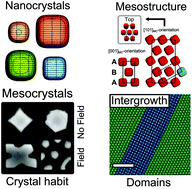
A precise control over the meso- and microstructure of ordered and aligned nanoparticle assemblies, i.e., mesocrystals, is essential in the quest of exploiting collective material properties for potential applications. In this work, we produce evaporation-induced self-assembled mesocrystals with different mesostructures and crystal habits based on iron oxide nanocubes by varying the nanocube size and shape, and by applying magnetic fields. A full 3D characterization of the mesocrystals was performed using image analysis, high-resolution scanning electron microscopy and Grazing Incidence Small Angle X-ray Scattering (GISAXS). This enabled structural determination of e.g. multi-domain mesocrystals with complex crystal habits, and the quantification of interparticle distances with sub-nm precision. Mesocrystals of small nanocubes (l = 8.6 – 12.6 nm) are isostructural with a body centred tetragonal (bct) lattice whereas assembly of the largest nanocubes in this study (l = 13.6 nm) additionally form a simple cubic (sc) lattice. The mesocrystal habit can be tuned from a square, hexagonal to star-like and pillar shapes depending on the particle size, shape, and the strength of the applied magnetic field. Finally, we outline a qualitative phase diagram of the evaporation-induced self-assembled superparamagnetic iron oxide nanocube mesocrystals based on nanocube edge length and magnetic field strength.


2016-04-28

[Workshop] Structure elucidation from molecular to macroscopic level


Functional Hybrid Materials: structure elucidation from molecular to macroscopic level – A workshop and training school

Speakers and lecturers

Thomas Albrecht-Schmitt, Florida State University
Zoltán Bacsik, Stockholm University
Lennart Bergström, Stockholm University
Luís Carlos, University of Aveiro
Marie-Helene Delville, Institute of Chemistry of Condensed Matter of Bordeaux
Thierry Darmanin, University of Nice
Niklas Hedin, Stockholm University
Andrew Ken Inge, Stockholm University
Vadim Kessler, Swedish University of Agricultural Sciences
Nicholas Kotov, University of Michigan
Carita Kvarnström, University of Turku
Danielle LaurencinInstitute Charles Gerhard of Montpellier
Jean-Marie Nedelec, Institute of Chemistry of Clermont-Ferrand
Tomás Plivelic, MAX IV synchrotron
Meital Reches, Hebrew University of Jerusalem
João Rocha, University of Aveiro
German Salazar-Alvarez, Stockholm University
Nico Sommerdijk, Eindhoven University of Technology
Andreas Taubert, University of Potsdam
Wei Wan, Stockholm University
Max Wolff, Uppsala University
Xiaodong Zou, Stockholm University

The school aims at giving an overview of structure elucidation techniques relevant for the design of new hybrid materials. A recommendation of 1.5 ECTS will be given to students attending all lectures and presenting a poster. Deadline registration April 30th, 2016.

Registration free of charge. Details at http://www.tinc.nu/

Organizers
German Salazar-Alvarez, Stockholm University
Vadim KesslerSwedish University of Agricultural Sciences

Sponsored by:

2015-07-02

[OPEN ACCESS] Rod Packing in Chiral Nematic Cellulose Nanocrystal Dispersions Studied by Small-Angle X-ray Scattering and Laser Diffraction

Christina Schütz, Michael Agthe, Andreas B. Fall, Korneliya Gordeyeva, Valentina Guccini, Michaela Salajková, Tomás S. Plivelic, Jan P. F. Lagerwall, German Salazar-Alvarez, and Lennart Bergström
Langmuir 31 (2015) 6507–6513.
DOI: 10.1021/acs.langmuir.5b00924

Abstract
The packing of cellulose nanocrystals (CNC) in the anisotropic chiral nematic phase has been investigated over a wide concentration range by small-angle X-ray scattering (SAXS) and laser diffraction. The average separation distance between the CNCs and the average pitch of the chiral nematic phase have been determined over the entire isotropic–anisotropic biphasic region. The average separation distances range from 51 nm, at the onset of the anisotropic phase formation, to 25 nm above 6 vol % (fully liquid crystalline phase) whereas the average pitch varies from ≈15 μm down to ≈2 μm as ϕ increases from 2.5 up to 6.5 vol %. Using the cholesteric order, we determine that the twist angle between neighboring CNCs increases from about 1° up to 4° as ϕ increases from 2.5 up to 6.5 vol %. The dependence of the twisting on the volume fraction was related to the increase in the magnitude of the repulsive interactions between the charged rods as the average separation distance decreases.

2013-11-01

PhD Position in Analytical Transmission Electron Microscopy::Stockholm University, Sweden

Project title: Studies and characterization of interfaces in nanoscale materials using novel 3DEM techniques. 

Reference number: SU FV-3142-13 (project HT13-1).

Deadline: November 20, 2013

General information.

Stockholm University (http://www.su.se) is a modern university with a multicultural environment and is one of the world’s top 100 higher education institutes. Here more than 60,000 students and 5,000 staff are active within science, humanities and social sciences. The Department of Materials and Environmental Chemistry (MMK, http://www.mmk.su.se) is a leading institution with research spanning over Materials and Solid State Chemistry focusing on different classes of materials, from ceramics and glasses to self-assembled and porous materials. The work often encompasses synthesis, characterisation by X-ray diffraction and electron microscopy, NMR studies, and modelling with computer simulations. Environmental aspects are also an important part of the research activities, where refined natural or anthropogenic chemicals and materials are studied in relation to their impact in our global environment.

Project description.

Synthetic and naturally occurring nanostructured materials are the building blocks of nanoscience and nanotechnology. These nanostructures often exhibit novel properties as their physical dimensions become comparable to certain characteristic length scales, which situate them at the border between quantum effects and bulk properties.
Nanomaterials composed of two phases often shown interesting interfacial phenomena. This project focuses on developing element specific three-dimensional electron microscopy (3DEM) to obtain compositional and crystallographic information at the interface of such nanoscale materials and correlate it with optical and magnetic properties. The project will be carried out in close collaboration with other groups at Stockholm University and international partners in Spain, Denmark and USA.

Relevant publications:
1.   E. Wetterskog, C.W. Tai, J. Grins, L. Bergström and G. Salazar-Alvarez, ACS Nano 2013 7, 7132.
2.   G. Salazar-Alvarez, H. Lidbaum, A. López-Ortega, M. Estrader, K. Leifer, J. Sort, S. Suriñach, M. D. Baró, and J. Nogués, Journal of the American Chemical Society 2011 133, 16738.
3.   K.L. Krycka, J. A. Borchers, G. Salazar-Alvarez, A. López-Ortega, M. Estrader, S. Estradé, E. Winkler, R.D. Zysler, J. Sort, F. Peiró, Maria Dolors Baró, C.C. Kao, and J. Nogués, ACS Nano 2013 7, 921.
4.   S. Disch, E. Wetterskog, R. P. Hermann, G. Salazar-Alvarez, P. Busch, T. Brueckel, L. Bergström, S. Kamali, Nano Letters 2011, 11, 1651.

Funding: The project will be funded by the recently approved KAW project “3DEM-
NATUR” (http://www.mmk.su.se/page.php?pid=945).

More information.

About the project: Doc. Germán Salazar-Alvarez, Group leader, german@mmk.su.se (http://www.mmk.su.se/page.php?pid=155&id=1303)
About MMK: Prof. Gunnar Svensson, Head of Department, gunnar.svensson@mmk.su.se.

Starting date: the anticipated starting date is February 1, 2014, or later.

How to apply.

Interested candidates should send their application and supporting material to: registrator@su.se with reference number SU FV-3142-13 in the subject field.

Your application should contain:
  • An application on the form (can be found at www.mmk.su.se/page.php?pid=413) together with CV and documentation of study merits, where your eligibility is clearly documented (see below).
  • A "Letter of intent", describing your expectations of the PhD studies connected to the project.
  • IMPORTANT: Please combine all your documents into a single, self-contained pfd-file, including the cover letter.


Eligibility.

To be eligible for PhD studies in chemistry, an education at the undergraduate level of at least 240 credits is required (corresponding to three years of full-time studies on undergraduate level and one year on advanced level) with at least 60 credits in chemistry or physics. Those studies should include at least one specialized course or a thesis in the research subject. In order to facilitate the evaluation of merits and suitability for the PhD studies your curriculum vitae (CV) should contain information about the extent and focus of the academic studies. The quantity (as part of an academic year) and the quality mark of courses in chemistry and physics are of particular interest. Please, state titles of undergraduate theses and project works. Further information is found in the home page, www.mmk.su.se/page.php?pid=413.
A selection committee will assess the candidate´s ability to successfully complete the PhD program and invite short-listed candidates to an interview in person or via internet. The study merits are an important selection criterion. Economic support for the graduate studies is guaranteed for full time studies during the time agreed in the individual study syllabus (study plan), normally for four years of full time studies, see  www.mmk.su.se/page.php?pid=413.
2013-03-05

[OPEN ACCESS] Structural diversity in iron oxide nanoparticle assemblies as directed by particle morphology and orientation


Nanoscale, 2013, Just Accepted Manuscript

Sabrina Disch,  Erik Wetterskog,  Raphaël P. Hermann,  Denis Korolkov,  Peter Busch,  Peter Boesecke,  Olivier Lyon,  Ulla Vainio,  German Salazar-Alvarez,  Lennart Bergström and Thomas Brückel

DOI: 10.1039/C3NR33282A

Abstract:

The mesostructure of ordered arrays of anisotropic nanoparticles is controlled by a combination of packing constraints and interparticle interactions, two factors that are strongly dependent on the particle morphology. We have investigated how the degree of truncation of iron oxide nanocubes controls the mesostructure and particle orientation in drop cast mesocrystal arrays. The combination of grazing incidence small angle X-ray scattering and scanning electron microscopy shows that mesocrystals of highly truncated cubic nanoparticles assemble in an fcc-type mesostructure - similar to arrays formed by iron oxide nanospheres, but with a significantly reduced packing density and displaying two different growth orientations. Strong satellite reflections in the GISAXS pattern indicate a commensurate mesoscopic superstructure that is related to stacking faults in mesocrystals of the anisotropic nanocubes. Our results show how subtle variation in shape anisotropy can induce oriented arrangements of nanoparticles of different structures and also create mesoscopic superstructures of larger periodicity.

2012-06-21

Strongly exchange coupled inverse ferrimagnetic soft|hard, MnxFe3-xO4|FexMn3-xO4, core|shell heterostructured nanoparticles


Nanoscale, 2012,4, 5138-5147


Marta Estrader  Alberto López-Ortega  German Salazar-Alvarez Igor Golosovsky  Marianna Vasilakaki  Kalliopi Trohidou David Keavney  Randy Dumas  Jordi Sort  Sonia Estrade Dolors Baro  Santiago Suriñach  Francesca Peiro and Josep Nogués


Inverted soft|hard, in contrast to conventional hard|soft, bi-magnetic core|shell nanoparticles of MnxFe3-xO4|FexMn3-xO4 with two different core sizes (7.5 and 11.5 nm) and fixed shell thickness (~ 0.6 nm) have been synthesized. The structural characterization suggests that the particles have an interface with a graded composition. The magnetic characterization confirms the inverted soft|hard structure and evidences a strong exchange coupling between the core and the shell. Moreover, larger soft core sizes exhibit smaller coercivities and loop shifts, but larger blocking temperatures, as expected from spring-magnet or graded anisotropy structures. The results indicate that, similar to thin film systems, the magnetic properties of soft|hard core|shell nanoparticles can be fine tuned to match specific applications.

2012-01-17

[OPEN ACCESS] Quantitative spatial magnetization distribution in iron oxide nanocubes and nanospheres by polarized small-angle neutron scattering


Sabrina Disch, Erik Wetterskog, Raphaël P. Hermann, Albrecht Wiedenmann, Ulla Vainio, German Salazar-Alvarez, Lennart Bergström and Thomas Brückel

DOI: 10.1088/1367-2630/14/1/013025


By means of polarized small-angle neutron scattering, we have resolved the long-standing challenge of determining the magnetization distribution in magnetic nanoparticles in absolute units. The reduced magnetization, localized in non-interacting nanoparticles, indicates strongly particle shape- dependent surface spin canting with a 0.3(1) and 0.5(1) nm thick surface shell of reduced magnetization found for ~9 nm nanospheres and ~8.5 nm nanocubes, respectively. Further, the reduced macroscopic magnetization in nanoparticles results not only from surface spin canting, but also from drastically reduced magnetization inside the uniformly magnetized core as compared to the bulk material. Our microscopic results explain the low macroscopic magnetization commonly found in nanoparticles.

2011-09-21

[OPEN ACCESS] Shape Induced Symmetry in Self-Assembled Mesocrystals of Iron Oxide Nanocubes

http://pubs.acs.org/doi/abs/10.1021/nl200126v [OPEN ACCESS]

Nano Lett., 2011, 11 (4), pp 1651–1656
Sabrina Disch, Erik Wetterskog, Raphaël P. Hermann, German Salazar-Alvarez, Peter Busch, Thomas Brückel, Lennart Bergström, and Saeed Kamali
DOI: 10.1021/nl200126v


Abstract:
Grazing incidence small-angle scattering and electron microscopy have been used to show for the first time that nonspherical nanoparticles can assemble into highly ordered body-centered tetragonal mesocrystals. Energy models accounting for the directionality and magnitude of the van der Waals and dipolar interactions as a function of the degree of truncation of the nanocubes illustrated the importance of the directional dipolar forces for the formation of the initial nanocube clusters and the dominance of the van der Waals multibody interactions in the dense packed arrays.